Plug-in solar
Plug-In Solar in Texas: No State Law Yet, and What That Means
Texas has no plug-in solar law as of November 2026, so utility interconnection rules apply to balcony kits. What that means for buyers before the 2027 session.
Key facts
- As of November 2026, Texas has no plug-in solar law, and Bright Saver's tracker lists no bill filed in the state.
- Without a law, a plug-in kit is distributed generation under 16 TAC § 25.211, which calls for an application and an interconnection agreement.
- Electric cooperatives are bound only by one subsection of that rule, and municipal utilities such as Austin Energy and CPS Energy set their own terms.
- The Texas Legislature meets in odd-numbered years; the next regular session convenes in January 2027.
- Texas's average residential rate was 15.91 cents per kWh in August 2026, below the national average of 18.16 cents, according to the EIA.
Texas has no plug-in solar law. As of November 2026, no bill allowing plug-in or balcony solar has been filed in Austin, according to the Bright Saver tracker, so a kit that feeds your home’s wiring counts as distributed generation. For most Texas utilities, that means an application and an interconnection agreement before you connect. The earliest a law could pass is the 2027 legislative session, which begins in January.
Is plug-in solar legal in Texas?
Nothing in Texas law bans a plug-in kit, and nothing gives it a category of its own. That second point is what matters. In the ten states with signed plug-in solar laws, by the Bright Saver tracker’s count, a certified device of up to 1,200 W (1,920 W in Colorado) is exempt from the interconnection process. In Texas, no such exemption exists, so the general rules for any generator connected to the grid apply, however small the generator is.
Bright Saver, the nonprofit that tracks these bills and sells kits in states with laws, describes Texas as a legal gray area and does not ship kits there. Its tracker lists Texas among the states with no legislation. For how other states handle it, see plug-in solar laws by state.
Which rules apply instead
Texas has three kinds of electric service, and each sets interconnection rules differently.
| Where you live | Who handles interconnection | Rule |
|---|---|---|
| Competitive areas of ERCOT (Dallas, Houston, Fort Worth, Corpus Christi and others) | Your transmission and distribution utility: Oncor, CenterPoint, AEP Texas or TNMP | 16 TAC § 25.211 and § 25.212 |
| Municipal utility areas (Austin Energy, CPS Energy in San Antonio and others) | The city utility | Its own interconnection rules |
| Electric cooperatives (Pedernales and others) | The cooperative | Its own rules; only subsection (o) of § 25.211 applies |
Section 25.211 of the Public Utility Commission’s rules covers on-site distributed generation. It requires the customer to submit an application for interconnection and parallel operation and to sign an interconnection agreement on the commission’s forms. For pre-certified equipment, as the rule defines it, the rule is relatively friendly: no pre-interconnection study fee for units up to 500 kW that meet its feeder limits, and interconnection within four weeks of a complete application. It was written for rooftop systems, not for a cord and an outlet, but nothing in it exempts a plug-in kit.
In the competitive market, your retail electric provider sells you electricity, but the poles, wires and meter belong to the distribution utility. Interconnection goes through the distribution utility, not the company on your bill.
What happens if you plug in anyway
A plug-in kit will work in Texas the same way it works in Utah: the microinverter synchronizes with the grid and feeds the outlet. The difference is the paperwork. Operating a generator in parallel with the grid without the application and agreement the rule calls for can breach your service terms. Utilities rarely detect a 400 W device, and we know of no enforcement against one, but rarely enforced is not the same as allowed.
The practical risks are elsewhere. An unlisted kit bought online may lack reliable anti-islanding protection or may put more current on a shared circuit than the wiring was designed for. Insurers may ask about an undisclosed generator after a fire. Those risks exist in every state, but in Texas no law sets a minimum certification for the device.
Doing it by the book: a small interconnection
If you want a kit now and want to be on solid ground, ask your distribution utility, municipal utility or cooperative whether it will accept a small inverter-based system under its interconnection process. Expect it to want:
- an application with the inverter model and its listing (UL 1741 for grid-interactive inverters)
- a signed interconnection agreement
- possibly a permitted installation by a licensed electrician, a dedicated circuit or an external disconnect
That turns a plug-in kit into a small conventional installation and adds cost, which often defeats the purpose of a 400 W or 800 W kit. Ask before you buy, and get the answer in writing. Our guide on telling your utility about plug-in solar covers what to ask.
Export credit in Texas
Texas has no statewide net metering. In the competitive market, some retail electric providers offer buyback plans that pay for exported electricity, but they require a formally interconnected system and a meter that records exports. Municipal utilities and cooperatives have their own programs. A kit plugged in without interconnection exports its surplus unpaid, and depending on the meter, exports may not be recorded correctly at all.
When could Texas pass a law?
The Texas Legislature meets in regular session in odd-numbered years. The 89th session ended on June 2, 2025 without a plug-in solar bill, and Bright Saver reports that none was introduced. The 90th Legislature convenes in January 2027. Any plug-in solar bill would have to be filed and passed in that session, which ends in late May or early June, and many Texas laws take effect on September 1 of the session year.
Whether one will be filed is open. More than thirty states had bills in 2026 by the same count, and states with laws now include neighbors of very different politics, from Utah to Virginia. You can follow filings on Texas Legislature Online and on the Bright Saver tracker.
What a Texas law would likely contain
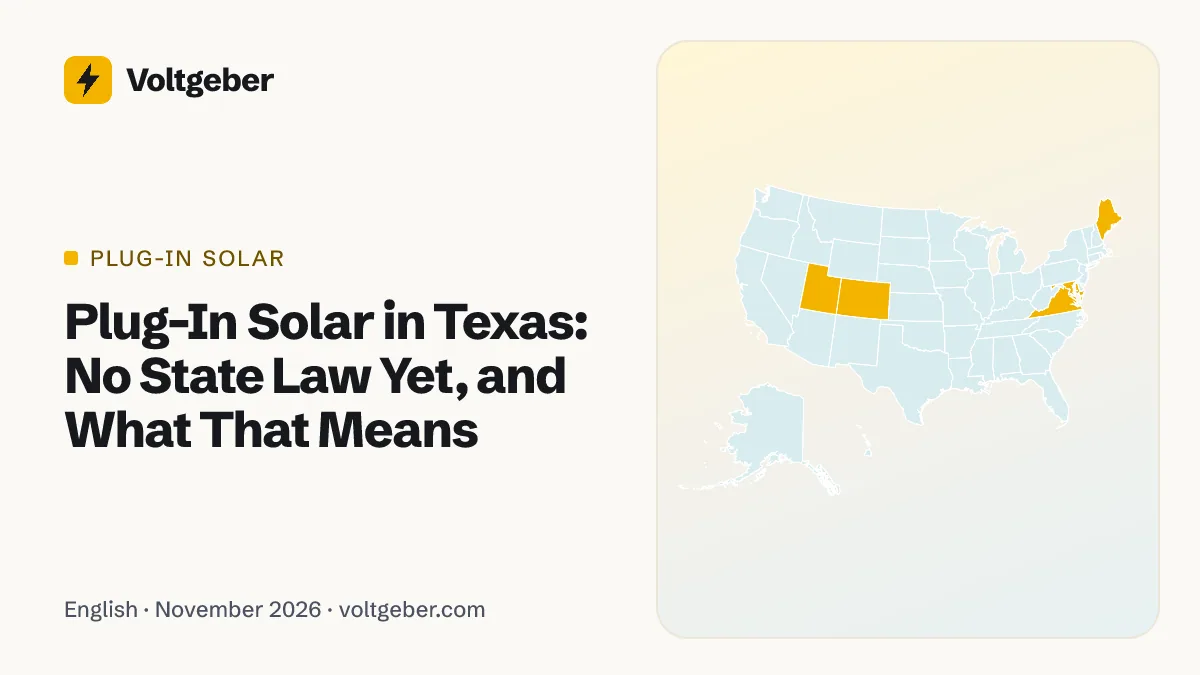
If a bill is filed in 2027, it would most likely follow the pattern of the ten states that have acted, because most of those laws share model language. Expect a cap of around 1,200 W of output per device or per meter, a requirement that the device be certified by a nationally recognized testing laboratory and stop feeding the grid in an outage, and an exemption from the interconnection agreement. Most of the recent laws also forbid utilities from requiring approval or fees but let them require a short notice; Virginia’s and Maryland’s require one before installation.
Texas would have its own wrinkle: in the competitive market, the company that bills you and the company that owns the wires are different. A bill would have to say which of them receives any notice and how retail providers treat exported electricity. For how the existing laws handle these questions, see our pages on Maryland and Virginia.
HOAs, renters and condos
Texas Property Code section 202.010 voids most property owners’ association rules that prohibit or restrict solar energy devices, with exceptions: an association may still restrict devices on common property, devices installed without its prior approval, and devices outside the roof unless they sit in a fenced yard or patio the owner owns, below the fence line. It was written for rooftop and ground systems. Whether it covers a portable plug-in kit, and how it applies in a condominium, has not been tested as far as we know. Renters have no specific right; the lease decides. Our guides for renters and on HOA rules cover the conversation.
What a kit could save in Texas
Texas’s average residential rate was 15.91 cents per kWh in August 2026, according to the EIA, below the national average of 18.16 cents. Production estimates come from the PVWatts model (National Laboratory of the Rockies, formerly NREL), panels facing due south. They assume you use all of it yourself.
| Kit size (panels) | Houston, tilted 30° | Dallas, tilted 30° | Vertical railing, Dallas | Value at 15.91 ¢/kWh |
|---|---|---|---|---|
| 400 W | about 570 kWh | about 610 kWh | about 350 kWh | $55 to $95 |
| 800 W | about 1,140 kWh | about 1,210 kWh | about 710 kWh | $115 to $195 |
| 1,200 W | about 1,710 kWh | about 1,820 kWh | about 1,060 kWh | $170 to $290 |
A vertical panel in Houston produces about 790 kWh a year per kilowatt, roughly 45 percent less than a tilted one, because the summer sun stands so high. Texas sun is strong, but the rate is low, and a summer afternoon load of air conditioning absorbs a kit’s output easily. Our cost and savings guide shows how to estimate your payback.
What Texans can do now
- Decide whether to wait for the 2027 session or go through your utility’s interconnection process now.
- If you go ahead, call your distribution utility, municipal utility or cooperative, describe the kit and ask in writing what it requires.
- Buy only a kit whose inverter is listed to UL 1741, and preferably one listed as a complete plug-in system under UL 3700; see our inverter guide.
- Check your HOA rules or lease and get written permission.
- Tell your insurer about the generator.
- Use a dedicated outlet, never an extension cord or a power strip.
Next steps
Frequently asked questions
Is plug-in solar legal in Texas?
No law allows or bans it. As of November 2026, Texas has no plug-in solar statute, so a kit that feeds your home's wiring is distributed generation under your utility's interconnection rules, which generally require an application and an agreement before you connect.
Can I plug a solar panel into an outlet in Texas without telling Oncor or CenterPoint?
Technically the kit will work, but the interconnection rule for Texas utilities calls for an application and a signed interconnection agreement for any generator operating in parallel with the grid. Plugging in without them can breach your service terms, even if enforcement against a small kit is rare.
Is there a balcony solar bill in Texas?
Not as of November 2026. Bright Saver's tracker lists no Texas bill, and its Texas page says none was introduced. The Legislature's next regular session begins in January 2027, which is the earliest a bill could be filed and passed.
Do Texas electric cooperatives allow plug-in solar?
Each cooperative sets its own interconnection rules, because only one subsection of the state's distributed generation rule applies to cooperatives. Some may accept a small inverter-based system with a simple application; ask yours in writing before you buy.
Can I get paid for exported electricity from a plug-in kit in Texas?
Texas has no statewide net metering. Some retail electric providers offer buyback plans, but they require a formally interconnected system and a meter that records exports. A kit plugged in without interconnection exports unpaid.
Can my HOA ban solar in Texas?
Texas Property Code section 202.010 limits how property owners' associations may restrict solar energy devices on owners' property. Whether it reaches a portable plug-in kit, especially in a condo or a rented apartment, has not been tested as far as we know.
Sources
- 16 Tex. Admin. Code § 25.211: Interconnection of on-site distributed generation
- 16 Tex. Admin. Code § 25.212: Technical requirements for interconnection and parallel operation of on-site distributed generation
- Texas Legislature Online
- Texas Property Code § 202.010: Regulation of solar energy devices
- Is plug-in solar legal in Texas?
- Plug-in solar legislation tracker
- Electric Power Monthly, Table 5.6.A: average price of electricity to ultimate customers by state
- PVWatts Calculator
This guide is general information, not legal, tax or electrical advice. Your utility, state and local code have the final say.