Plug-in solar
Plug-In Solar Inverters: How Balcony Microinverters Work
A plug-in solar inverter turns panel DC into 120 V AC and shuts off when the grid fails. Ratings, UL 1741 vs UL 3700, sizing, zero export and what to check.
Key facts
- A plug-in solar inverter converts the panels' direct current into 120 V, 60 Hz alternating current and must stop feeding within seconds when the grid fails.
- UL 3700, the outline of investigation for interactive plug-in photovoltaic equipment and systems, was published in December 2025; UL Solutions opened certification in January 2026.
- Electrek reported Hoymiles' HiFlow Pro, a 360 W microinverter, as the first US microinverter certified to UL 3700 in July 2026.
- California's SB 868 requires certification as a plug-in photovoltaic system, the strictest wording of the state laws we have read.
- State caps of 1,200 W apply to inverter output; on 120 V that is 10 amps.
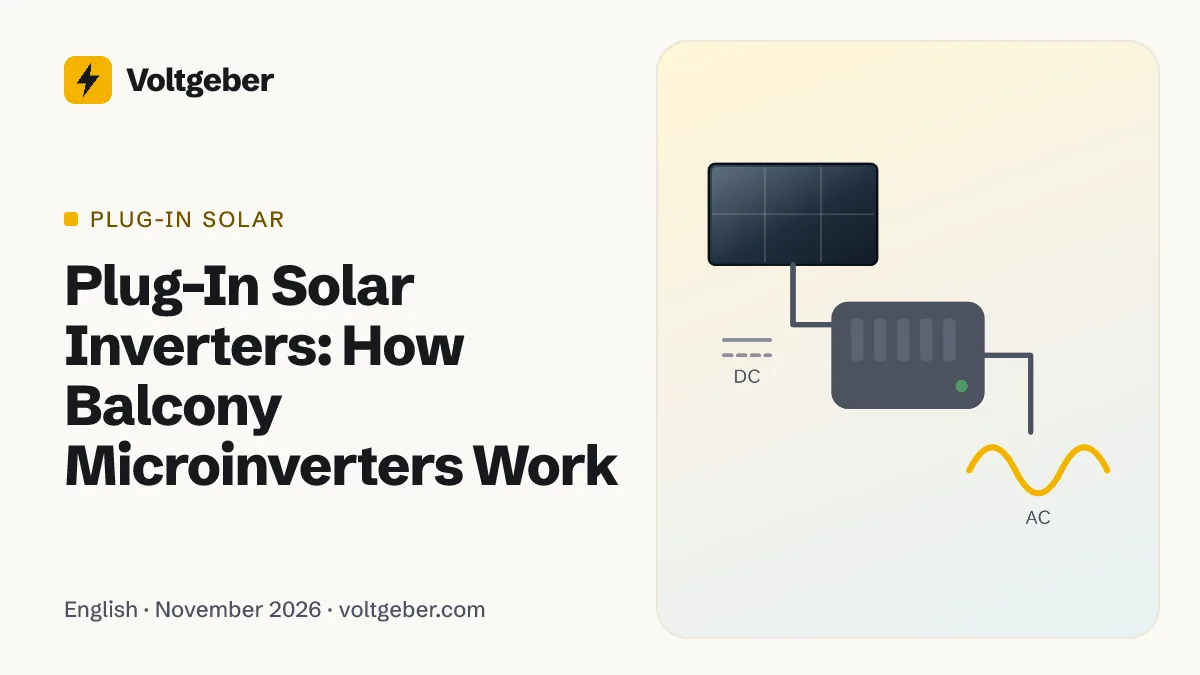
A plug-in solar inverter, also called a balcony solar inverter, is the box behind the panels that turns their direct current into the 120 V, 60 Hz alternating current of a US outlet, synchronizes it with the grid and switches off within seconds when the grid fails. It is almost always a microinverter. Its AC output rating, usually up to 1,200 W in total, is the number state laws cap.
What a plug-in solar inverter does
Solar panels produce direct current at a voltage that changes with light and temperature. The inverter does four jobs with it:
- Tracks the maximum power point. It constantly adjusts the load on each panel to pull the most power out of it, a function called MPPT.
- Converts and synchronizes. It turns the DC into AC that matches the grid’s voltage, frequency and phase, so current flows from the kit into your home’s wiring.
- Protects the grid. If the grid voltage disappears, it stops feeding within seconds. This anti-islanding behavior protects line workers and is a certification requirement.
- Protects you at the plug. A plug-in design must ensure the prongs carry no dangerous voltage once unplugged, which a rooftop inverter never had to consider.
Electricity from the kit takes the shortest path: whatever is running in your home uses it first, and only the surplus flows out through the meter. Our explainer on how plug-in solar works covers the whole system.
Microinverter, string inverter or hybrid
| Type | How it works | Use in plug-in solar |
|---|---|---|
| Microinverter | One small unit per one to four panels, mounted behind them | The standard; low DC voltage, each panel works independently, easy to add units |
| String inverter | One central unit fed by panels wired in series at high DC voltage | Rare; high DC voltages are a poor fit for a balcony and a plug |
| Hybrid or battery inverter | Combines solar input, a battery and AC output in one unit | Used in kits with storage; may offer a separate outlet that runs during outages |
Microinverters dominate because they keep DC voltage low, typically under 60 V per panel, and because shade on one panel does not drag down the others. A railing with a shadow from the floor above is exactly the case they handle best.
Reading an inverter datasheet
These are the ratings that matter, with examples from published datasheets:
| Rating | What it means | Example |
|---|---|---|
| Rated AC output | The most the unit delivers to the outlet; this is what state caps count | Hoymiles HiFlow Pro: 360 W per unit, according to Electrek |
| Maximum DC input | The panel power the unit accepts; can exceed AC output | CraftStrom’s listed inverter: 420 W input, 350 W peak output |
| MPPT voltage range | The panel voltage window in which it tracks power | Must match the panels’ operating voltage |
| AC voltage and frequency | 120 V, 60 Hz for US outlets | Enphase’s European balcony kit is 230 V, 50 Hz and cannot be used in the US |
| Enclosure rating | Protection against water and dust | NEMA Type 6 for the HiFlow Pro; IP67 for Enphase’s IQ8HC |
| Operating temperature | Ambient range | -40 to 65°C for the HiFlow Pro |
| Warranty | Length of manufacturer coverage | 25 years for Enphase IQ8HC microinverters |
Read the AC output, not the panel total on the box. A kit advertised as “1,600 W” may combine 1,600 W of panels with inverters that deliver less, or may exceed your state’s cap. Our guide to the 1,200 W limit explains how the laws measure it.
Certification: UL 1741, UL 3700 and what the laws require
Two standards matter for a US plug-in inverter.
UL 1741 is the established safety standard for grid-interactive inverters, used for every rooftop system. It covers the inverter’s behavior during grid faults, including anti-islanding. A UL 1741 listing on a microinverter is necessary but describes only the inverter.
UL 3700 is the Outline of Investigation for Interactive Plug-In Photovoltaic Equipment and Systems. UL published the first edition in December 2025 and UL Solutions announced a testing and certification program built on it on January 8, 2026. It addresses the risks specific to a device that feeds a household outlet: contact with live parts, safe installation, overloads and current flowing where it should not. The first microinverter reported as certified to it was Hoymiles’ HiFlow Pro, in July 2026, according to Electrek. How many complete kits carry a UL 3700 system listing as of November 2026 is something to check product by product; we have not found a public list we could verify.
What the state laws ask for differs:
| State | Certification wording |
|---|---|
| California (SB 868) | Certified as a plug-in photovoltaic system by UL or an equivalent laboratory, with a certified isolation feature |
| Virginia (§ 56-596.8) | Certified by a nationally recognized testing laboratory under 29 C.F.R. § 1910.7, and meets the NEC |
| Maryland (§ 7-321) | Certified by Underwriters Laboratories or an equivalent laboratory |
| Colorado (HB26-1007) | Labeled and listed by a nationally recognized testing laboratory |
California’s wording points clearly to a complete-system listing; the others are satisfied, at least on paper, by a listed device. A European CE mark or a VDE-AR-N 4105 certificate, common on kits imported from Germany, counts for none of them. For your state’s rules, see plug-in solar laws by state.
The plug and the electrical code
The National Electrical Code has no definition for plug-in solar as of November 2026. In October 2026 the NFPA published six proposed tentative interim amendments, numbered 1951 to 1956, that would add one: a new part of Article 705 for cord-and-plug connected sources, rules for the receptacle, the plug as disconnecting means, labels, panel calculations and utility notification. Public comment runs until November 20, 2026; whether they are adopted is open.
The connector itself is unsettled. The authors behind those amendments, who work for GismoPower, the company that filed them, write that section 6.4.1.3 of UL 3700 rules out standard connectors such as the NEMA plug used on household devices. We have not been able to read the outline’s text to confirm that, so ask the seller exactly how a certified kit connects to your outlet before you buy.
Sizing the inverter to the panels
Inverters are often paired with somewhat more panel power than their AC rating, a ratio of 1.1 to 1.3 being common. On most days the panels never reach their rating, especially on a vertical railing, so the extra panel wattage raises annual output. On a cold, clear noon, the inverter clips at its rating and wastes a little. As long as the AC output stays within the cap, the law is satisfied; the kit must still be certified as built.
Respect the input limits. Panel voltage rises in cold weather, and exceeding the inverter’s maximum DC voltage can damage it. Match panel current to the inverter’s input current limit too.
Zero export and current sensors
Some kits throttle the inverter whenever production exceeds what the home uses, so nothing flows into the grid. That requires a current sensor on the home’s supply. CraftStrom’s PowerMeter, for example, uses clamp-on sensors that its FAQ says attach to the two main lines in the breaker box, and adjusts the inverters every 0.1 seconds. Opening a breaker panel is electrician work in most homes and is not allowed in most rentals.
None of the state laws we have read require zero export. Maryland and Virginia forbid utilities from requiring controls beyond those integrated into the device. Zero export can still make sense where exported power earns nothing and a meter might count it wrongly, which the Maryland Public Service Commission warns can happen.
Batteries and outages
A grid-interactive inverter cannot power your home during an outage; it shuts off. Kits with a battery handle this with a separate outlet on the battery or gateway. Enphase’s European IQ Balcony Gateway, for example, has an auxiliary socket rated at 2,760 W that can run appliances from solar during a daytime outage, according to its datasheet. That product is for 230 V markets only; see our page on the Enphase IQ balcony solar kit.
How to choose a plug-in solar inverter
- Start from your state’s cap and choose inverters whose total AC output stays within it.
- Confirm 120 V, 60 Hz output and a UL 1741 listing, and ask for a UL 3700 certificate for the complete kit.
- Match the panels’ voltage and current to the inverter’s input range, including cold-weather voltage.
- Check the enclosure rating for outdoor mounting and the operating temperature range for your climate.
- Decide whether you need zero export or a battery, and whether that means work inside the breaker panel.
- Keep the datasheet and certificate; some states’ notification forms ask for the model and the certifying laboratory.
Next steps
Frequently asked questions
What inverter do I need for plug-in solar?
A grid-interactive microinverter, or a set of them, with an AC output within your state's cap, usually 1,200 W, at 120 V and 60 Hz. It should be listed to UL 1741, and ideally the complete kit should be certified to UL 3700, the outline written for plug-in systems.
Can I use any microinverter for balcony solar?
Any grid-tied microinverter will technically feed an outlet if you wire a plug to it, but that does not make it a plug-in system. The state laws require certification by a recognized laboratory, and California requires certification as a plug-in photovoltaic system, which a rooftop microinverter with a homemade cord does not have.
What is the difference between UL 1741 and UL 3700?
UL 1741 is the long-standing safety standard for grid-interactive inverters, including their behavior during grid faults. UL 3700 is a newer outline of investigation for plug-in photovoltaic equipment and systems, covering risks specific to a device that feeds a household outlet, such as touch safety at the plug and circuit overload.
Does a plug-in solar inverter work during a power outage?
No. Anti-islanding protection shuts it off within seconds when the grid fails, so that no current flows toward line workers, and certification requires it. Some kits with a battery offer a separate outlet on the battery unit, which can run devices plugged directly into it.
What is a zero-export inverter setting?
A zero-export setup uses a current sensor on your home's supply to throttle the inverter whenever production exceeds consumption, so nothing flows to the grid. It requires clamps on the main conductors, usually inside the breaker panel, which is electrician territory in most homes. None of the state laws we have read require it.
How many panels can one microinverter handle?
It depends on the model: many plug-in microinverters take one or two panels, others up to four. Match the panels' voltage and current to the inverter's input range, and keep the total AC output within your state's cap.
Sources
- UL Solutions debuts testing and certification framework for safer plug-in solar across the United States
- Hoymiles launches the first US UL 3700 balcony solar microinverter
- SB-868 Electricity: portable solar generation devices (Chapter 985, Statutes of 2026)
- Assembly Committee on Utilities and Energy: analysis of SB 868 (hearing June 10, 2026)
- Colorado Session Laws 2026, Chapter 127 (HB26-1007), signed act
- Code of Virginia § 56-596.8: small portable solar generation devices
- Balcony Solar
- Our National Electrical Code has no definition for plug-in solar. Six amendments would give it one
- NFPA 70 Proposed Tentative Interim Amendment 1951
- IQ Balcony Solar Kit data sheet (Germany), DSH-00489-3.0
- 1200 Watt Eco-Line plug&play solar: product page
This guide is general information, not legal, tax or electrical advice. Your utility, state and local code have the final say.