Plug-in solar
Balcony Solar Mounting Brackets and Hooks: Types, Loads, Rules
Balcony solar brackets and hooks clamp to railings of about 2 to 3 inches, hang panels flat or tilted, and must resist wind. Types, fit, loads and permissions.
This guide is still being verified. Some details may change.
Key facts
- Railing brackets sold for balcony solar typically clamp round railings up to about 50 to 63 mm (2 to 2.5 inches) and square rails up to about 44 to 80 mm, depending on the model.
- A panel hung vertically produces roughly a third less a year than one tilted 30 degrees south, according to PVWatts estimates for Denver and Baltimore.
- A 400 W glass panel weighs roughly 40 to 55 pounds and has about 20 square feet of surface, so wind, not weight, is the main load.
- Building codes design guards for a 200-pound concentrated load and 50 pounds per linear foot; a solar panel adds wind forces the railing was not designed around.
- Virginia lets landlords set reasonable rules on a device's size, place and manner of placement; Colorado lets HOAs require it to be secured.
Balcony solar mounting brackets and hooks clamp a panel to a railing, either hanging flat against it or tilted toward the sun. Typical railing brackets fit round top rails up to about 2 to 2.5 inches and square rails up to about 1.7 to 3 inches. A panel’s weight is rarely the problem; wind is. Get written permission before you clamp or drill.
Types of balcony solar mounts
| Mount | How it attaches | Typical tilt | Best for | Watch out for |
|---|---|---|---|---|
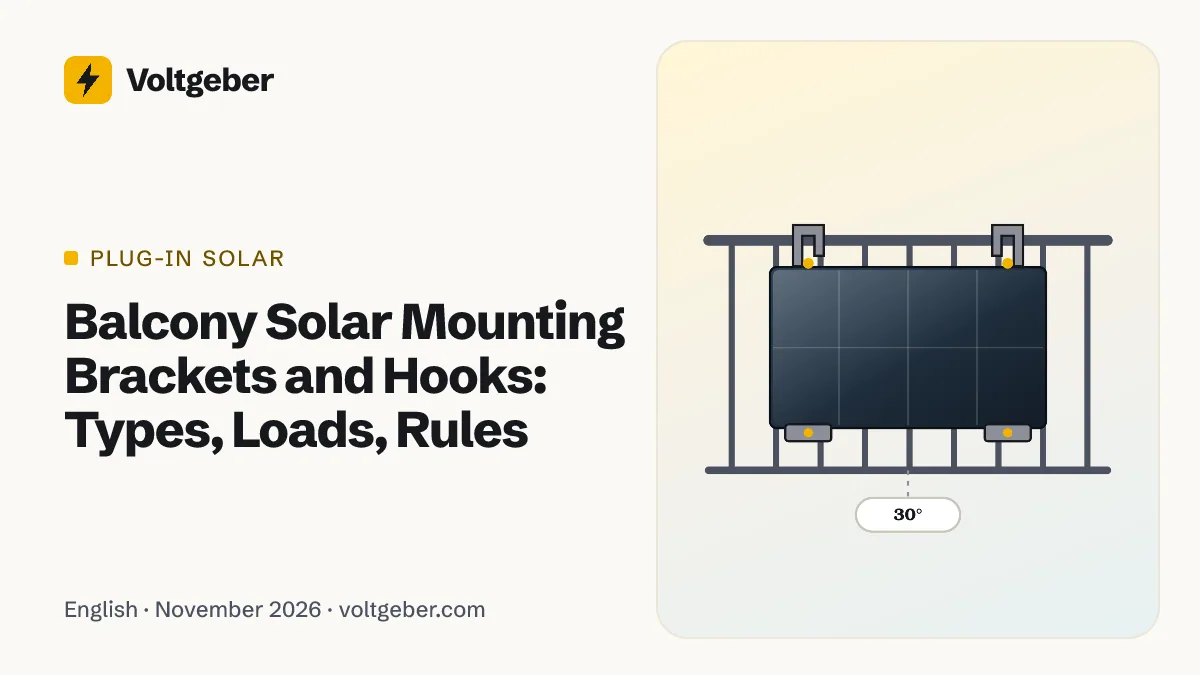
| Flat railing hooks | Hooks over the top rail; panel hangs against the railing | 0° (vertical) | Rentals, HOAs that want nothing protruding | Lowest yield; panel must be secured at the bottom too |
| Tilting railing brackets | Clamp to the top rail, arms push the panel’s lower edge out | About 10° to 45°, depending on model | South-facing balconies where tilt is allowed | More wind load and more visible from the street |
| Wall brackets | Bolted into the façade or a balcony wall | Adjustable | Owners who can drill | Needs owner’s consent; anchors must suit the wall |
| Floor stands | Freestanding frame with ballast on the balcony floor | About 15° to 35° | Balconies with deep floors and solid parapets | Ballast weight on the slab; takes floor space |
| Ground or flat-roof frames | Ballasted or anchored frames in a yard or on a roof | About 10° to 35° | Houses, garages, flat roofs | Roof membrane protection and wind ballast |
Most US renters end up with one of the first two. The choice between them is mostly a trade between yield and how much the panel sticks out.
Flat or tilted: how much yield you give up
A panel hung vertically on a south-facing railing catches the low winter sun well but misses much of the high summer sun. PVWatts estimates from the National Laboratory of the Rockies (formerly NREL) put the loss at about a third against a 30-degree tilt for Denver and Baltimore, and around 40 percent for Los Angeles, where the summer sun stands higher.
| City | Tilted 30°, kWh per year per kW of panels | Vertical, kWh per year per kW | Loss when vertical |
|---|---|---|---|
| Denver | about 1,640 | about 1,105 | about 33% |
| Baltimore | about 1,420 | about 925 | about 35% |
| Los Angeles | about 1,705 | about 990 | about 42% |
A modest tilt of 15 to 20 degrees recovers much of the difference while keeping the panel close to the railing. East- or west-facing balconies lose more than south-facing ones in either position. Our cost and savings guide shows what those kilowatt-hours are worth.
What railing brackets fit
Bracket data sheets list the railing shapes and sizes they clamp. Many of the products on the market were designed for European balconies, where the plug-in market is older, so dimensions come in millimeters. Examples from published specifications:
| Specification | Example values |
|---|---|
| Round top rail | Up to 50 mm (about 2 in.) on MUNK’s bracket; up to 63 mm (about 2.5 in.) on Offgridtec’s holder |
| Square or rectangular rail | Up to 80 x 60 mm (about 3.1 x 2.4 in.) on MUNK’s angular version; up to 44 mm (about 1.7 in.) on Offgridtec’s |
| Panel size | Up to 210 x 120 cm (about 83 x 47 in.) on MUNK’s bracket |
| Bracket weight | About 3 kg (6.6 lb) per set of two, per MUNK |
| Material | Anodized aluminum or stainless steel |
Measure the top rail’s outside diameter or width and the gap between the top rail and the floor. Check the panel’s frame depth too: brackets clamp frames of a given thickness, for example 30 to 35 mm on Offgridtec’s holder. If your railing is glass, cable or decorative wrought iron, standard hooks may not fit at all.
Weight and wind: the loads that matter
A typical 400 W glass panel weighs roughly 40 to 55 pounds and measures about 67 by 45 inches, about 20 square feet. CraftStrom’s smaller 200 W panels weigh 11.2 kg, about 25 pounds, according to its product page. Most railings carry that weight easily.
Wind is different. As a rough illustration, not an engineering calculation, a 90 mph gust exerts a velocity pressure of about 20 pounds per square foot; on 20 square feet of panel that is roughly 400 pounds before shape and exposure factors. Building codes design guards to resist a 200-pound concentrated load and 50 pounds per linear foot along the top, under section 1607 of the International Building Code. They were not designed around a sail bolted to the top rail. Upper floors, corners and coastal sites see the highest wind.
What that means in practice:
- prefer flat mounting on upper floors and in windy locations
- use at least two attachment points at the top and secure the bottom edge, so the panel cannot swing or flap
- choose brackets with a published wind rating where you can find one, and compare it with local design wind speeds
- if the railing is loose, corroded, glass or thin aluminum, ask the building owner or a structural engineer first
How to attach a panel securely
Clamps and hooks are only as good as their hardware. Use stainless steel bolts with lock nuts or thread lock, and check them after the first storm and each spring. Rubber pads between clamp and railing protect the finish and stop the bracket from sliding. Add a steel safety cable from the panel frame to the railing post, so a failed clamp does not drop a panel onto the sidewalk. Zip ties degrade in sunlight and are not a mounting method.
Route the cable from the microinverter to the outlet without pinching it in a door or window. Flat window cable feed-throughs exist for exactly this. Keep the inverter shaded and ventilated behind the panel, as its data sheet requires. Our guide to plug-in solar inverters covers enclosure and temperature ratings.
What landlords, HOAs and state laws say about mounting
The state plug-in solar laws mostly regulate utilities, but two touch mounting directly. Virginia’s law, from January 1, 2027, stops landlords with more than four rental units from banning a device on the exterior of a tenant’s premises, but lets them set reasonable restrictions on size, place and manner of placement and requires seven days’ notice from the tenant. Colorado’s law, from January 1, 2027, stops HOAs from prohibiting a device but lets them require the owner to secure it reasonably to the unit and to bear the liability. Details are on our pages for Virginia and Colorado.
Elsewhere, your lease, condo bylaws or HOA rules decide. Describe the mount, the weight, whether anything is drilled and how the panel is secured, and get approval in writing. Our guides for renters and on HOA rules cover the conversation, and the state law overview covers the rest of the rules.
Common mounting mistakes
- Mounting over a sidewalk without a tether. A falling panel is the main liability risk of balcony solar.
- Tilting steeply on a high floor. More yield, much more wind.
- Drilling in a rental. Even where a law protects the device, it rarely covers holes in the building.
- Ignoring the bottom edge. Hooks alone let a panel swing and hammer the railing in wind.
- Blocking a fire escape or egress path. Floor stands must not narrow a required exit route.
How to choose and install a balcony mount
- Measure the top rail, the railing height and the panel’s dimensions and frame depth.
- Decide on flat or tilted mounting based on orientation, floor height, wind exposure and what your landlord or HOA allows.
- Pick brackets whose data sheet covers your railing shape and size and your panel size, ideally with a wind rating.
- Get written permission describing the mount and how it is secured.
- Install with stainless hardware, two top attachments per panel, a secured bottom edge and a safety cable.
- Route the cable to the outlet without pinching, and check every bolt after the first storm.
Next steps
Frequently asked questions
How do you mount solar panels on a balcony railing?
With brackets or hooks that clamp around the top rail and the panel frame, usually two per panel, plus a lower attachment that stops the panel swinging. Use stainless steel hardware, lock nuts and a safety tether, and never rely on zip ties alone.
What size railing do balcony solar brackets fit?
Published specifications range from round railings up to about 50 mm (2 inches) on some brackets to about 63 mm (2.5 inches) on others, and square or rectangular rails from about 44 mm up to 80 by 60 mm. Measure your top rail before you buy and compare it with the bracket's data sheet.
Should balcony solar panels be tilted or flat?
Tilting a south-facing panel to around 30 degrees produces roughly a third more a year than hanging it flat against the railing, according to PVWatts estimates. A tilted panel catches more wind, though, and many landlords and HOAs only allow panels that stay within the railing's outline.
Can a balcony railing hold a solar panel?
Most railings can carry the weight of one or two panels; the question is wind. A panel acts like a sail, and a strong gust can put several hundred pounds of force on it. If the railing is old, loose, glass or lightweight aluminum, ask the building owner or a structural engineer before mounting.
Do I need permission to mount solar panels on my balcony?
Usually, yes. Your lease, condo bylaws or HOA rules govern what you attach to the building. Virginia lets larger landlords set reasonable rules on size, place and manner but not ban devices outright, and Colorado lets HOAs require a device to be secured but, from 2027, not prohibit it.
What are alternatives to railing mounts?
Wall brackets, freestanding stands with ballast on the balcony floor, ground stands in a yard, and ballasted frames on a flat roof. Stands avoid loading the railing and allow a better tilt, but take floor space and need ballast against wind.
Sources
- Balcony bracket for solar panels (order no. 930710, 930711): product specifications
- Solar module holder for balcony railings, frame height 30-35 mm, adjustable angle
- 1200 Watt Eco-Line plug&play solar: panel dimensions and weight
- International Building Code, Section 1607 (loads on handrails and guards)
- Virginia Acts of Assembly, 2026 Reconvened Session, Chapter 1052 (§ 55.1-1212.1, small portable solar generation devices)
- HB26-1007, reengrossed bill text (common interest communities)
- PVWatts Calculator
This guide is general information, not legal, tax or electrical advice. Your utility, state and local code have the final say.