Plug-in solar
Plug-In Solar in Colorado: 1,920 W Law, HOAs and Utility Rules
Colorado's HB26-1007 has allowed plug-in solar up to 1,920 W since August 12, 2026. Listing, notification, the 391 W tier, HOAs and renters explained.
Key facts
- Colorado's HB26-1007 was signed on May 7, 2026 and took effect on August 12, 2026, according to the General Assembly's bill page.
- A qualifying device supplies at most 1,920 W, is listed by a nationally recognized testing laboratory and shuts off in a power outage.
- One system per address and one device per wall outlet: utilities may not require approval, charge a fee or demand extra equipment, but may ask you to report the device and its size.
- Devices of 391 W or less are exempt from Colorado's solar installer rules and from code provisions that would require rewiring.
- From January 1, 2027, nobody may unreasonably prohibit a plug-in device, HOAs included, and devices above 391 W must be UL labeled and listed to be sold, leased or rented.
Plug-in solar, also called balcony solar, is legal in Colorado. House Bill 26-1007 took effect on August 12, 2026 and allows one listed device per address with up to 1,920 W of output, the highest cap of any state. Your utility may not require approval, fees or extra equipment, but may ask you to report the device. Devices of 391 W or less skip the installer and rewiring rules.
Is plug-in solar legal in Colorado?
Yes. Governor Jared Polis signed HB26-1007 on May 7, 2026, and the General Assembly’s bill page lists it as Chapter 127 of the 2026 session laws, effective August 12, 2026. The bill carries the dry title “Improve Customer Use Distributed Energy Resources” and does two things: it creates a legal category for what it calls a portable-scale solar generation device, and it forces utilities to accept meter collar adapters, a separate topic covered further down.
Before the law, a Colorado utility could treat any generator running in parallel with the grid like a rooftop system, with an application, a review and sometimes a fee. That remains true for anything that falls outside the new definition. For a device inside it, the approval step is gone.
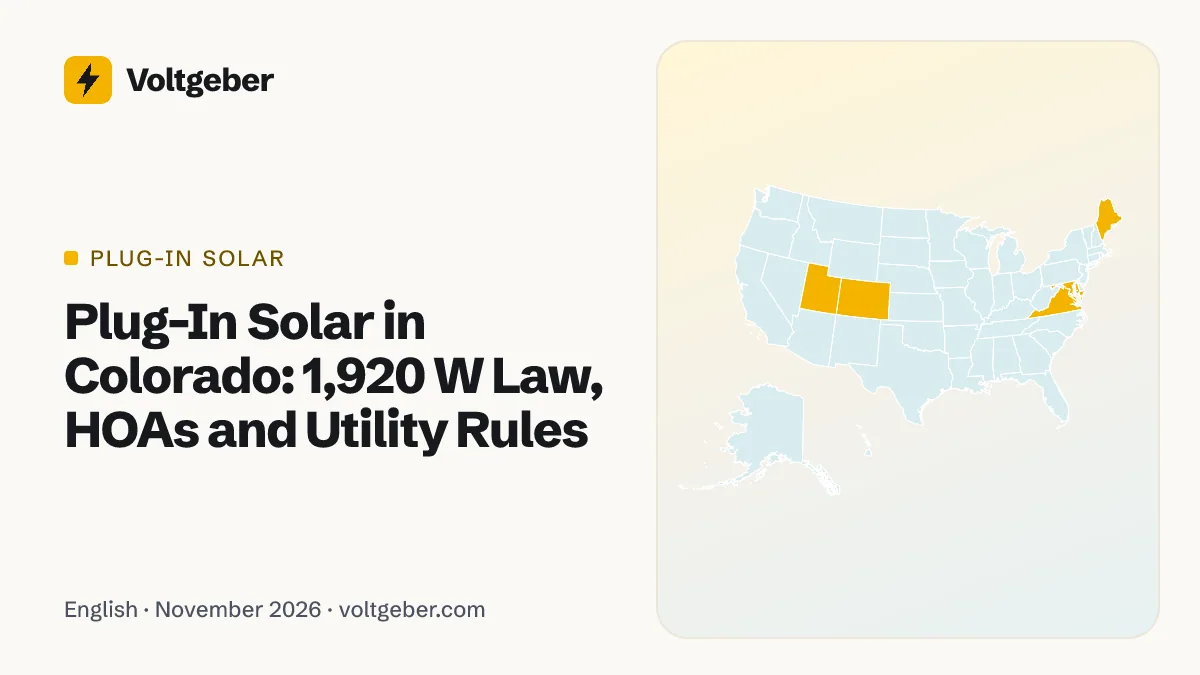
By signing date, Colorado was the fourth state with such a law, after Utah, Maine and Virginia, and it went further than any of them on size. For the national picture, see plug-in solar laws by state.
What HB26-1007 allows
The rules below come from the signed act, published as Chapter 127 of the 2026 Session Laws, which adds section 40-2-140 to the Colorado Revised Statutes. Bright Saver and Colorado Springs Utilities describe it the same way.
| Rule | What the law says |
|---|---|
| Maximum output | 1,920 W supplied to the grid |
| Devices | One photovoltaic system per address; no more than one device on a single wall outlet |
| Certification | Labeled and listed by a nationally recognized testing laboratory |
| Outage behavior | Must include a feature that stops it energizing the grid in a power outage |
| Utility approval | Not required; no fee; no extra controls beyond what the listing includes |
| Utility notification | A utility may require you to report the device’s presence and size in kilowatts |
| 391 W tier | Exempt from Colorado’s solar installer requirements and from code provisions that would require rewiring |
| HOAs and other bans | From January 1, 2027: no unreasonable prohibition by anyone; HOAs may not prohibit; reasonable restrictions allowed |
| Sales | From January 1, 2027: a device above 391 W may not be sold, leased or rented unless UL labeled and listed |
| Building and fire code | Still apply |
The 1,920 W figure corresponds to 16 amps at 120 V, the continuous limit of a 20-amp circuit under the usual 80 percent rule. That is a different target from the 1,200 W cap in Utah, Maryland, Virginia and California, which keeps a device within 10 amps. Our guide to the 1,200 W limit explains why most states settled there.
The 391 W tier: when you need an electrician
The law splits devices into two tiers. A device that puts out 391 W or less is exempt from the solar installation requirements in Colorado statute section 40-2-128 and from building code or listing provisions that would require changes to the building’s wiring. In plain terms: one panel and a small microinverter, plugged into an existing outlet, with no electrician.
Above 391 W, the device is still legal up to 1,920 W, but the ordinary electrical and building codes apply. Colorado Springs Utilities, a municipal utility, reads it this way on its plug-in solar page: up to 391 W plugs into a standard outlet and typically needs no electrician or permit; from 392 to 1,920 W the system must meet local codes, and extra electrical work may require a licensed electrician and permits; above 1,920 W it is not a portable-scale device at all and follows the normal interconnection process.
In practice, a 1,920 W device will usually need a dedicated 20-amp circuit, which is electrician work in most homes. A two-panel kit of around 800 W sits in between: legal, but whether your city wants a permit or a dedicated circuit is a question for the local building department.
Do you have to tell your utility?
You do not need permission. The law bars any retail electric provider, including investor-owned Xcel Energy, municipal utilities and rural cooperatives, from requiring approval before you install or use a qualifying device, from charging a fee related to it and from requiring equipment beyond what its listing already includes.
What a utility may do is require notification: the presence of the device and its size in kilowatts. Whether your utility asks, and how, is up to the utility. Colorado Springs Utilities says it does not require approval or charge a fee and gives an email contact for questions. As of November 2026 we have not found a published notification form from Xcel Energy; check its website or call before you plug in. Our guide on telling your utility about plug-in solar covers how to word a notice.
Nothing in HB26-1007 changes net metering. A plug-in device exports its surplus unpaid, and many smart meters record exported electricity separately rather than running backwards.
HOAs, landlords and the January 1, 2027 date
Two dates matter. The device rules took effect on August 12, 2026. The protections against bans start on January 1, 2027. From then on, no person may unreasonably prohibit the installation or use of a qualifying device, and any covenant or restriction that does so is unenforceable. A property owner may impose reasonable restrictions, including prior notice of the installation and rules on fire and overload risks, damage and the device’s location. Common interest communities get a specific rule: the device counts as an energy efficiency measure, an owner may install it on a limited common element such as a balcony, and the association may require the owner to secure it to the unit and to bear liability and costs.
For renters, the law does not create a right to drill into the building. Because the ban on unreasonable prohibitions applies to any person, it reads on its face as covering landlords too, who may in turn require prior notice and set reasonable rules; no court has tested this yet. Bright Saver reads the law as not requiring landlord permission for a kit that is neither drilled nor wired into the structure; Colorado Springs Utilities advises checking with landlords, property managers and HOAs on placement and appearance first. We would get written permission for anything that hangs over a railing. Our guide for renters and the HOA guide cover the conversation.
Meter collars: the other half of the law
HB26-1007 also orders the Colorado Public Utilities Commission to revise its interconnection rules by December 31, 2026 so that customers may own and use meter collar adapters approved by a recognized testing laboratory. A meter collar sits between the meter socket and the utility meter and lets a larger solar system, battery or EV charger connect without a panel upgrade. Utilities must keep a public list of at least one approved adapter. This is not plug-in solar, but it is the path for homeowners who outgrow 1,920 W.
Certification: what “listed” means in practice
The law requires a listing by a nationally recognized testing laboratory, and its utility clause refers to the device’s UL listing. It does not name a specific standard. The relevant one is UL 3700, an outline of investigation for interactive plug-in photovoltaic equipment and systems, for which UL Solutions opened a certification program in January 2026. The first microinverters certified to it appeared in mid-2026. Ask the seller for the listing of the complete system, not only a UL 1741 listing of the inverter. Our inverter guide explains the difference.
The signed act also says that from January 1, 2027, a device with an output above 391 W may not be sold, leased or rented in Colorado unless it is UL labeled and listed. An earlier House version had applied that rule to devices of 391 W or less; the final text reversed it.
What a kit can save in Colorado
Colorado’s average residential rate was 17.17 cents per kWh in August 2026, according to the EIA. Production estimates below come from the PVWatts model (National Laboratory of the Rockies, formerly NREL) for Denver, per kilowatt of panels facing due south. They assume you use every kilowatt-hour yourself, so treat them as an upper bound; surplus leaves unpaid.
| Kit size (panels) | Tilted 30°, kWh/year | Vertical railing, kWh/year | Value at 17.17 ¢/kWh |
|---|---|---|---|
| 400 W | about 650 | about 440 | $75 to $115 |
| 800 W | about 1,310 | about 880 | $150 to $225 |
| 1,200 W | about 1,970 | about 1,330 | $230 to $340 |
| 1,920 W | about 3,150 | about 2,120 | $365 to $540 |
Colorado’s altitude and clear winters make it one of the better states for a small array. The catch is self-consumption: an apartment drawing 150 W around the clock absorbs a 400 W kit almost completely but only part of a 1,920 W device at noon. Our cost and savings guide shows how to estimate your share.
How to set up plug-in solar in Colorado
- Pick the size. Up to 391 W needs no electrician; above that, ask your building department whether it wants a permit and whether your outlet’s circuit is suitable.
- Check the listing. Ask the seller for the certificate of the complete system from a recognized testing laboratory, and confirm the device stops feeding in an outage.
- Check your utility’s notification rule on its website or by phone, and send the device’s size in kilowatts if it asks.
- Get written permission from your landlord, or check your HOA rules if you install before January 1, 2027.
- Mount the panels securely; railing and wall mounts are covered in our mounting bracket guide.
- Plug into one outlet only, with no extension cord or power strip, and never put a second system on the same address.
Common mistakes
- Two kits at one address. The law defines the device as a single system per address. A second kit puts both outside the definition.
- Assuming 1,920 W means any outlet. Above 391 W the electrical code applies. A large device on a shared 15-amp kitchen circuit is the scenario the code is meant to prevent.
- Buying an unlisted kit online. A European CE mark or an inverter-only listing does not satisfy the law.
- Forgetting the HOA before 2027. Until January 1, 2027, the ban on HOA prohibitions is not yet in force.
Next steps
Frequently asked questions
Is plug-in solar legal in Colorado?
Yes. HB26-1007 took effect on August 12, 2026 and created a legal category for portable-scale solar generation devices of up to 1,920 W. A device that is listed by a recognized testing laboratory and stops feeding the grid in an outage needs no approval from your utility.
What is the wattage limit for balcony solar in Colorado?
1,920 W of output to the grid, one device per address. That is the highest cap of any state law we have read; most other states, including Utah, Maryland, Virginia and California, stop at 1,200 W.
Do I need an electrician for plug-in solar in Colorado?
Not for a device of 391 W or less, which the law exempts from the solar installer rules and from code provisions that would require rewiring. Above 391 W the normal electrical and building codes apply, and Colorado Springs Utilities, for one, advises consulting a licensed electrician.
Do I have to tell Xcel Energy about my plug-in solar kit?
The law lets any utility require you to report the presence and size of the device in kilowatts, but not to approve it or charge a fee. Check your utility's website or call before you plug in; as of November 2026 we have not found a published Xcel Energy form.
Can my HOA ban balcony solar in Colorado?
Not from January 1, 2027. From that date the law treats a plug-in device as an energy efficiency measure that an association may not prohibit, and it allows installation on a limited common element such as a balcony. The association may still set reasonable restrictions, require you to secure the device and make you bear the liability. Until then, existing HOA rules still matter.
Does Colorado pay me for the electricity my kit exports?
No. HB26-1007 removes the approval step, not the rules for net metering. Electricity you do not use flows to the grid unpaid, so a kit pays off through what you consume yourself.
Sources
- HB26-1007: Improve Customer Use Distributed Energy Resources (bill page, status and effective date)
- Colorado Session Laws 2026, Chapter 127 (HB26-1007), signed act
- Plug-in solar energy
- Is plug-in solar legal in Colorado?
- Plug-in solar legislation tracker
- Colorado approves balcony solar, requires utilities to accept meter collars
- UL Solutions debuts testing and certification framework for safer plug-in solar across the United States
- Electric Power Monthly, Table 5.6.A: average price of electricity to ultimate customers by state
- PVWatts Calculator
This guide is general information, not legal, tax or electrical advice. Your utility, state and local code have the final say.