Plug-in solar
Plug-In Solar in Virginia: The 1,200 W Law From January 2027
Virginia's HB 395 allows plug-in solar up to 1,200 W from January 1, 2027, with a utility notice before installation and new rights for many renters.
Key facts
- Virginia's HB 395 (Chapter 1052) was approved on April 22, 2026; its plug-in solar rules take effect on January 1, 2027.
- A qualifying device delivers at most 1,200 W per customer, or per unit in multifamily housing, and is certified by a recognized testing laboratory.
- You must notify your utility on a State Corporation Commission form before installing; if it does not respond within 15 days, you may install.
- Landlords with more than four rental units may not prohibit a tenant's device on the exterior of the tenant's premises, but may set reasonable rules.
- Devices of 391 W or less are exempt from listing provisions that would require changes to wiring or panels.
Plug-in solar, also called balcony solar, becomes legal in Virginia on January 1, 2027. House Bill 395, approved by Governor Abigail Spanberger on April 22, 2026, exempts a certified device of up to 1,200 W per customer from interconnection rules and utility approval. You must notify your utility on a state form before installing. Landlords with more than four units may not ban the devices outright.
Is plug-in solar legal in Virginia right now?
Not yet. The law is enacted, but its first enactment clause, the one that contains the plug-in solar rules, takes effect on January 1, 2027. Until then, a plug-in kit is treated like any other generator connected to your home’s wiring, which means your utility’s interconnection and net metering rules apply. For Dominion Energy, Appalachian Power and the electric cooperatives, those rules generally require an application and approval before a generator runs in parallel with the grid.
If you buy a kit in late 2026, the sensible course is to wait until January, or ask your utility in writing whether it will accept a notice under the new law early. Nothing in the statute gives you that right before the effective date.
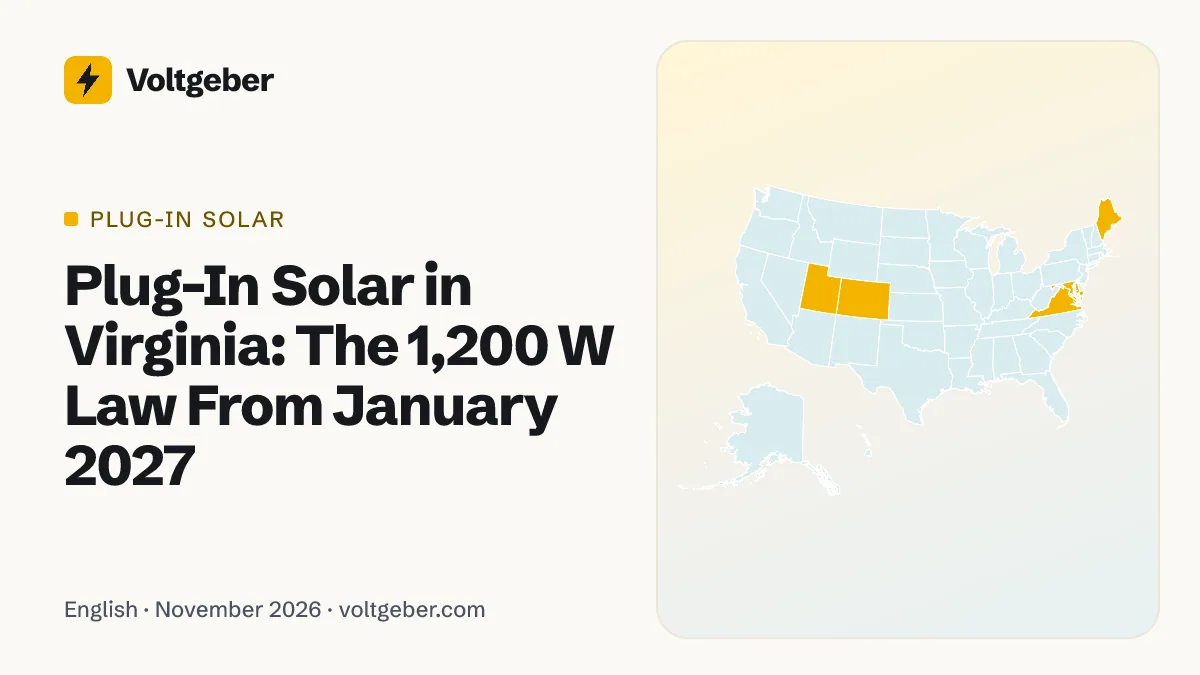
In March 2026, pv magazine USA described Virginia as the second state to send a plug-in solar bill to its governor; by signing date, it was the third state with a law, after Utah and Maine. HB 395 and its Senate companion, SB 250, carried the same policy. The enacted text we read is Chapter 1052 of the 2026 Acts of Assembly. For how Virginia compares with other states, see plug-in solar laws by state.
What the Virginia law says
Chapter 1052 adds a section to Title 56 of the Code of Virginia, enacted as § 56-596.7 and now published as § 56-596.8, and a matching section to the Residential Landlord and Tenant Act. It also amends the net metering statutes and the Virginia Consumer Protection Act.
| Rule | What the law says |
|---|---|
| Effective date | January 1, 2027 |
| Maximum output | 1,200 W per customer, or per residential unit in multifamily housing |
| Connection | Through an electrical outlet, on the customer’s side of the meter |
| Code | Meets the most recent version of the National Electrical Code |
| Certification | Certified by a nationally recognized testing laboratory under 29 C.F.R. § 1910.7 |
| Outage behavior | Must not affect the building’s system or export power in a power outage |
| Utility approval | Not required; no fee; no additional controls beyond what is integrated |
| Notification | Required before installation, on the State Corporation Commission form |
| 391 W tier | Exempt from listing provisions that would require changes to wiring or panels |
| Net metering | Not available for these devices |
| Utility liability | No utility or cooperative is liable for damage caused by a device |
The cap is measured as the device’s maximum power output, which in practice is the inverter’s AC rating. Our guide to the 1,200 W limit explains why most states settled on that number and how panel wattage relates to it.
The notification form and the 15-day window
Virginia is stricter than Colorado on paperwork. Before you install, you must notify your electric service provider by submitting the form established by the State Corporation Commission, online or by mail. The utility then has 15 days to review the form for accuracy and completeness and to tell you about any deficiencies. If it does not respond within 15 days, the law treats the notification requirement as met and you may install.
The act required the Commission to publish the form by September 1, 2026, and limited it to a short list of items:
- your name, contact details and the address where the device will be installed
- your electric service provider, account number and meter number
- the device’s model name and model number
- the name of the testing laboratory that certified it
As of November 3, 2026 we have not located the published form on the Commission’s or Dominion Energy’s websites; check both closer to January. Our guide on telling your utility about plug-in solar covers what to keep on file.
Disconnect switches
At a property with more than one plug-in device, or where the local distribution circuit requires it, the utility or cooperative may install an automatic, locking disconnect switch. As we read the act, it does not say who pays; Maryland’s law, by contrast, puts that cost on the customer. A disconnect switch is a meter-side installation, so expect to coordinate access with the utility.
The act also told the Secretary of Commerce and Trade to convene a work group on safety standards, including whether lockable disconnect switches add safety beyond what the National Electrical Code and testing laboratory standards already provide. Its report was due by November 15, 2026. Its recommendations could lead to changes in the 2027 session, so check for amendments before you rely on the details.
Renters: what landlords may and may not do
Virginia is one of the few states that gives tenants a real, if limited, right. Under the new § 55.1-1212.1, a landlord who owns more than four rental units in Virginia, or more than a 10 percent interest in more than four, may not prohibit a tenant from installing a qualifying device on the exterior of the tenant’s premises. The landlord may set reasonable restrictions on size, place and manner of placement, and may prohibit devices elsewhere on the property.
The tenant has obligations in return:
- give the landlord notice at least seven days before installing, with documentation that the device qualifies and the proposed location
- pay for any damage the device causes to the unit or premises
- get express written approval for anything that requires changes to the building, its wiring or its panels
Units billed through a ratio utility billing system, where the landlord divides a master-metered bill among tenants, are excluded entirely. Landlords with four or fewer units are not covered by the rule, so their lease terms decide. Our plug-in solar guide for renters covers the conversation with a landlord.
Localities, HOAs and condos
A Virginia city or county may not prohibit a qualifying device on a residential structure, provided it respects height and setback rules and any historic, architectural preservation or corridor protection district. That stops blanket local bans.
The same section is explicit that it does not override private agreements: recorded declarations and covenants, condominium instruments, cooperative instruments and property owners’ association declarations still apply. An HOA or condo association in Virginia can therefore still restrict balcony solar under its governing documents. Read them before you buy; our HOA guide explains what to look for.
Certification and safety
The law requires certification by a nationally recognized testing laboratory and compliance with the most recent National Electrical Code. It does not name a product standard. The one written for this category is UL 3700, an outline of investigation for interactive plug-in photovoltaic equipment and systems, for which UL Solutions opened a certification program in January 2026. The notification form asks for the name of the certifying laboratory, so keep the certificate.
The 391 W tier is narrower than it sounds. It exempts small devices from listing provisions that would require changes to the building’s wiring or panels; it does not exempt them from certification. Our inverter guide explains which listing to look for.
What a kit can save in Virginia
Virginia’s average residential rate was 17.64 cents per kWh in August 2026, according to the EIA. Production estimates come from the PVWatts model (National Laboratory of the Rockies, formerly NREL) for Richmond, panels facing due south. They assume you use all of it yourself; treat them as an upper bound.
| Kit size (panels) | Tilted 30°, kWh/year | Vertical railing, kWh/year | Value at 17.64 ¢/kWh |
|---|---|---|---|
| 400 W | about 550 | about 350 | $60 to $95 |
| 800 W | about 1,100 | about 700 | $125 to $195 |
| 1,200 W | about 1,660 | about 1,050 | $185 to $290 |
Because exported electricity earns nothing under the law, size the kit to your daytime use. Our cost and savings guide walks through the calculation.
How to install plug-in solar in Virginia from 2027
- Wait for January 1, 2027, or get your utility’s written agreement before then.
- Choose a kit of no more than 1,200 W of inverter output that is certified by a recognized testing laboratory and shuts off in an outage.
- If you rent from a landlord with more than four units, give seven days’ written notice with the certificate and the planned location. Otherwise, get permission under your lease.
- Check your HOA or condo documents, which the law does not override.
- Submit the State Corporation Commission notification form to your utility and wait up to 15 days for a response.
- Mount the panels securely and plug into a single outlet, with no extension cord or power strip.
Next steps
Frequently asked questions
Is plug-in solar legal in Virginia?
From January 1, 2027, yes. HB 395, approved on April 22, 2026, exempts certified devices of up to 1,200 W from interconnection requirements once you have notified your utility. Until that date, your utility's existing interconnection and net metering rules still apply.
Do I need Dominion Energy's approval for a balcony solar kit?
Not from January 1, 2027. The law bars any electric service provider from requiring approval, a fee or extra equipment for a qualifying device. You must still submit the State Corporation Commission's notification form before installing, and the utility has 15 days to flag errors.
Can my landlord stop me from installing plug-in solar in Virginia?
A landlord who owns more than four rental units in Virginia may not prohibit a device on the exterior of your premises, such as a balcony, but may set reasonable rules on size, place and manner. You must give seven days' notice with documentation that the device qualifies. Smaller landlords are not covered by this rule.
Can an HOA ban balcony solar in Virginia?
The law stops localities from banning the devices on residential buildings, but it expressly does not override recorded covenants, condominium instruments or property owners' association declarations. Check your community's rules before you buy.
What is the wattage limit for plug-in solar in Virginia?
1,200 W of maximum power output per customer, or per residential unit in multifamily housing. Devices of 391 W or less get an extra exemption from listing provisions that would require changes to the building's wiring or electrical panels.
Will I get net metering credit for a plug-in kit in Virginia?
No. The law exempts these devices from net energy metering provisions, so exported electricity is not credited. A kit pays off through the electricity you use yourself while it produces.
Sources
- Virginia Acts of Assembly, 2026 Reconvened Session, Chapter 1052 (HB 395), approved April 22, 2026
- Code of Virginia § 56-596.8: small portable solar generation devices; exempt from interconnection
- HB 395, 2026 Regular Session
- Plug-in solar legislation tracker
- Virginia becomes second U.S. state to advance plug-in solar legislation to the governor's desk
- UL Solutions debuts testing and certification framework for safer plug-in solar across the United States
- Electric Power Monthly, Table 5.6.A: average price of electricity to ultimate customers by state
- PVWatts Calculator
This guide is general information, not legal, tax or electrical advice. Your utility, state and local code have the final say.