Plug-in solar
Utah Plug-In Solar Law: What HB 340 Allows and Requires
Utah's HB 340 has allowed plug-in solar since May 7, 2025: up to 1,200 W on a 120 V outlet, certified, no utility approval or fee, no net metering.
Key facts
- Utah's HB 340, Solar Power Amendments, passed 72-0 in the House and 27-0 in the Senate, was signed on March 25, 2025 and took effect on May 7, 2025.
- A portable solar generation device may produce at most 1,200 W and must plug into a standard 120 V AC outlet.
- The device must comply with the National Electrical Code, be certified by UL or another recognized laboratory, and stop energizing the building during an outage.
- The utility may not require approval, a fee or extra equipment, and is not liable for damage the device causes.
- Utah's average residential rate was 13.31 cents per kWh in August 2026, among the lowest in the country (EIA, preliminary).
Utah’s HB 340 made Utah the first state to legalize plug-in solar. Since May 7, 2025, a “portable solar generation device” of up to 1,200 W may plug into a standard 120 V outlet without an interconnection agreement, utility approval or fee. It must comply with the National Electrical Code, be certified by a recognized testing laboratory and shut off during outages. It earns no net metering credit.
HB 340 at a glance
House Bill 340, titled Solar Power Amendments, was sponsored by Rep. Raymond Ward and Sen. Wayne Harper. It passed the House 72-0 and the Senate 27-0, was signed by Governor Spencer Cox on March 25, 2025, and took effect on May 7, 2025. It added a definition of a portable solar generation device to Utah’s utility code and a new section, 54-15-601, to the net metering chapter.
| Item | What the law says |
|---|---|
| Device | Moveable photovoltaic device, intended primarily to offset part of the customer’s own consumption |
| Output cap | maximum power output of not more than 1,200 W |
| Connection | standard 120 V AC outlet |
| Safety | complies with the current National Electrical Code; certified by UL or another nationally recognized testing laboratory |
| Outage protection | must include a device or feature that keeps it from energizing the building’s electrical system during an outage |
| Interconnection | exempt from the interconnection requirements in section 54-15-106; no agreement |
| Utility powers | may not require approval before installation, a fee, or controls or equipment beyond what is built in |
| Net metering | excluded |
| Liability | the utility is not liable for damage or injury caused by the device |
| Effective | May 7, 2025 |
The Legislature’s website refused our automated connections, so the table follows the bill status record, Utah Clean Energy’s summary, pv magazine USA’s reading of the substitute bill and published excerpts of the code section, which agree with each other.
What counts as a portable solar generation device
Four conditions matter in practice. The device must be moveable, which rules out panels bolted to the roof and wired into the panel. Its output must stay at or below 1,200 W, which is the AC output of the inverter. It must plug into an ordinary 120 V outlet, not a 240 V dryer outlet. And it must carry a certification from a recognized testing laboratory as a device that meets the electrical code.
The last condition took the longest to meet. When the law took effect, pv magazine USA quoted an industry participant saying that no available system met both the UL and the code requirements. UL Solutions launched a certification program based on its UL 3700 outline for plug-in solar in January 2026, explicitly citing Utah’s law. Hoymiles announced the first UL 3700-compliant plug-in microinverter in July 2026, and Utah Clean Energy noted later in the year that whole-system certification was not yet complete.
A UL 1741 inverter listing, which most microinverters carry, shows the inverter disconnects during an outage. It does not certify the kit as a plug-in device. As of November 2026, ask the seller which laboratory certified the complete product and to which standard.
What your utility can and cannot do
The law’s core is the exemption from the interconnection process. Before HB 340, any generator running in parallel with the grid needed an agreement with the utility, a review and sometimes a fee, however small it was. For a qualifying device, the utility may not:
- require you to obtain approval before installing or using it,
- charge any fee or charge related to it,
- require controls or equipment beyond what is integrated into the device.
In return, the utility is not liable for damage or injury the device causes. For most Utah households the utility is Rocky Mountain Power, the investor-owned utility regulated by the Public Service Commission. The obligations in section 54-15-601 are written for “electrical corporations,” Utah’s term for that kind of utility. Customers of municipal utilities, such as those in Provo, Murray or St. George, and of rural cooperatives should ask their utility how it applies the law.
No net metering: why the size of the kit matters
HB 340 excludes portable devices from Utah’s net metering program. Any electricity your kit produces beyond what your home uses at that moment flows to the grid without credit. That is the reason to size a kit to your daytime base load rather than to the cap.
Utah’s electricity is cheap, which stretches payback. EIA’s preliminary August 2026 average residential rate for Utah is 13.31 cents per kWh, against 18.16 cents nationally. Rep. Ward told KJZZ in 2026 that he had not noticed a reduction in his own bill for that reason. The table assumes south-facing panels and a yield of about 1.6 kWh per watt per year when tilted (PVWatts range for Salt Lake City, rounded).
| Setup | Yearly output | Used at home | Savings at 13.3 cents |
|---|---|---|---|
| 400 W, tilted | about 640 kWh | about 85% | about $70 |
| 800 W, tilted | about 1,280 kWh | about 70% | about $120 |
| 800 W, vertical railing | about 900 kWh | about 75% | about $90 |
| 1,200 W, tilted | about 1,920 kWh | about 60% | about $155 |
A 1,200 W kit uses only 60 percent of its output in a typical apartment, so the step from 800 W to 1,200 W adds less than it costs. Our cost and savings guide has prices as of November 2026, and what 1,200 W plug-in solar means explains the circuit limits.
What HB 340 does not change
The law is about the utility relationship and device safety. It leaves four things as they were:
- Your lease. Landlords may still prohibit attachments to railings or require approval. Utah has no tenant right to install a kit, unlike Virginia from 2027. See our guide for renters.
- HOA and condo rules. HB 340 says nothing about associations; see plug-in solar and HOA rules.
- Building and electrical codes. Your city may still have views on a mounting bracket over a sidewalk or on an outdoor outlet.
- Larger systems. Anything above 1,200 W, hardwired or not certified, remains an ordinary customer generator under the interconnection and net metering rules.
Setting up a kit under Utah’s law
-
Confirm your utility. Rocky Mountain Power customers are covered by section 54-15-601. Municipal and co-op customers should ask their utility first.
-
Choose a certified device. Look for certification of the complete device by a nationally recognized testing laboratory and an output of 1,200 W or less. A European kit with a 230 V inverter does not qualify.
-
Pick the outlet. Use a grounded, GFCI-protected 120 V outlet, ideally on a circuit that does not also serve a large appliance. Never use an extension cord or power strip.
-
Get permission where you need it. Landlord, condo board or HOA approval in writing, with a description of the mounting.
-
Tell your insurer. The utility is not liable for damage the device causes, so the risk sits with you and your renters or homeowners policy.
How Utah’s law compares with the states that followed
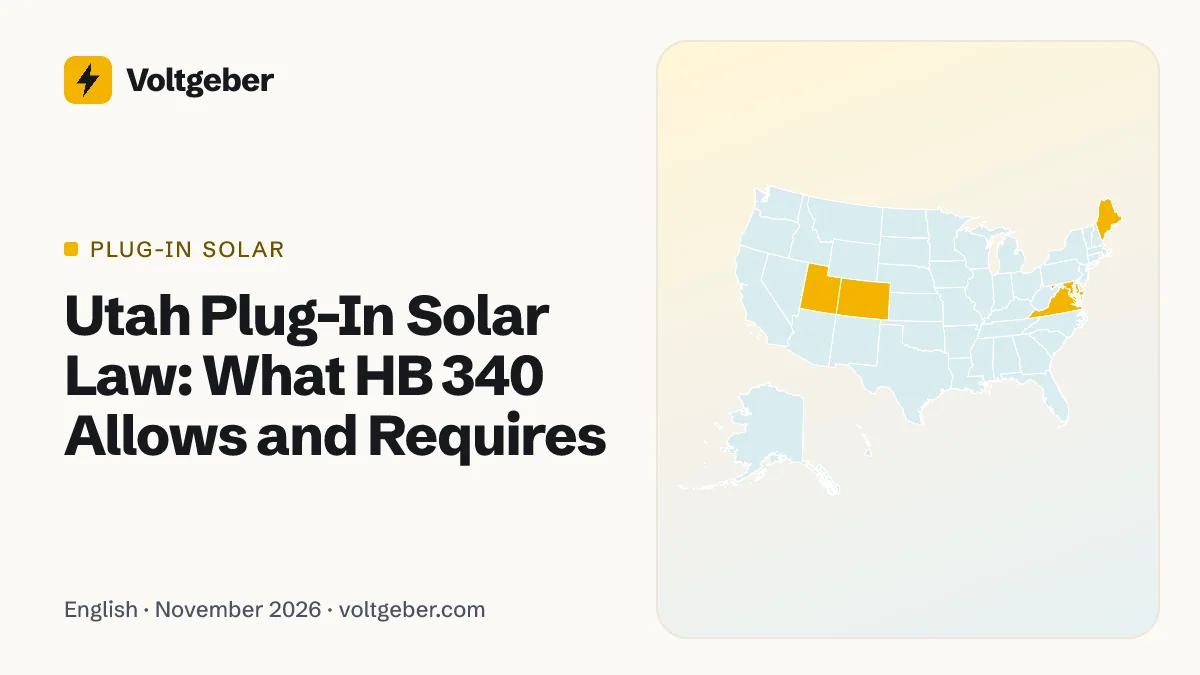
Utah’s language became the template for most later bills, and Bright Saver, which campaigns for them, counted ten signed state laws by November 2026. The later laws added details Utah does not have: Maine requires an electrician and a notice above 420 W, Maryland and Virginia require a notice before installation, and Virginia gives tenants of larger landlords a right to install from January 2027. Our plug-in solar laws by state overview tracks them.
Next steps
Frequently asked questions
Is plug-in solar legal in Utah?
Yes. Since May 7, 2025, HB 340 has allowed a portable solar generation device of up to 1,200 W to be plugged into a standard 120 V outlet without an interconnection agreement. The device must be certified by a recognized testing laboratory, comply with the National Electrical Code and shut off during an outage.
Do I need to tell Rocky Mountain Power about a plug-in solar kit?
The published summaries of HB 340 describe no notification duty, only a ban on requiring approval, fees or extra equipment. We could not open the enrolled bill text while researching this page, so we cannot rule out a notice clause. Telling the utility is harmless and can help if a question comes up later.
What is the wattage limit for plug-in solar in Utah?
The device's maximum power output may not exceed 1,200 W. That is the AC output that reaches the outlet, so you can pair slightly more panel capacity with a 1,200 W inverter. A 1,200 W device puts 10 amps on a 120 V circuit, which is why a dedicated outlet is the safer choice.
Can I get net metering for a plug-in kit in Utah?
No. HB 340 exempts portable solar generation devices from the net metering program as well as from interconnection rules. Electricity you export is not credited, so the kit should be sized to what your home uses during the day.
Does HB 340 let renters install balcony solar without landlord permission?
No. The law deals with the utility relationship and device safety. Your lease, condo rules and HOA covenants still apply, so get written permission before mounting anything on a balcony you do not own.
Are certified plug-in kits available in Utah?
Slowly. UL Solutions launched its UL 3700 certification program for plug-in solar in January 2026, and the first compliant microinverter was announced in July 2026. Utah Clean Energy wrote in 2026 that whole-system certification to UL 3700 was not yet complete, so check the certificate for the specific product.
Sources
- H.B. 340 Solar Power Amendments, enrolled copy (2025 General Session)
- Utah Code § 54-15-601: Portable solar generation device, exemptions, requirements
- UT HB 340 (2025): Solar Power Amendments, bill status
- Balcony solar gains unanimous bipartisan support in Utah
- What about plug-in solar?
- UL Solutions debuts testing and certification framework for safer plug-in solar
- Hoymiles introduces HiFlow Pro, the first UL 3700-compliant plug-in microinverter in the US
- Electric Power Monthly, Table 5.6.A: Average price of electricity to ultimate customers by state
- Plug-in solar panels bill failed in Arizona. Here's how the new law is working in Utah
This guide is general information, not legal, tax or electrical advice. Your utility, state and local code have the final say.