Plug-in solar
What Is Plug-In Solar? How Balcony Solar Works and Who It Is For
Plug-in solar is one to four panels, a microinverter and a cord to a standard outlet. How it works in the US, the UK and Germany, its limits, and who it suits.
Key facts
- A plug-in kit is one to four panels, a microinverter and a cord that plugs into a standard outlet. No electrician, no roof, no panel work.
- The electricity feeds your home's circuits first; you save the retail rate for every kilowatt-hour you use yourself, and the surplus leaves unpaid.
- Germany passed one million registered plug-in systems in mid-2025; its rule allows 800 W of inverter output and 2,000 W of panels with one online registration.
- US kits run from about 180 to 1,200 W and plug into 120 V outlets; most state laws that allow them cap the device at 1,200 W, Colorado at 1,920 W.
- A plug-in kit is grid-tied: it switches off in a blackout and gives no backup power unless it includes a battery.
- In Great Britain, plug-in solar has been legal since 27 August 2026 for kits of up to 800 W that meet the government's product specification, one per household, without a battery.
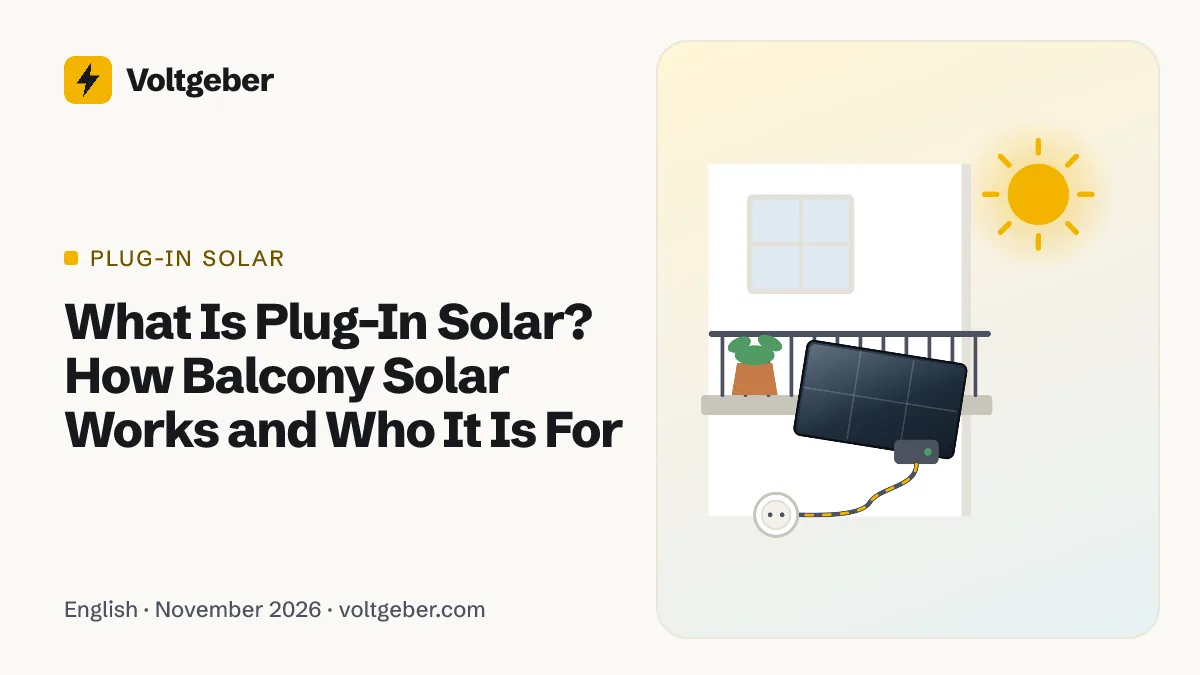
A plug-in solar kit, also called balcony solar, is a small solar system you plug into a standard outlet instead of wiring into your electrical panel. One to four panels feed a microinverter, the microinverter turns their direct current into the alternating current of your home, and the power flows through the outlet into your apartment’s circuits, where the refrigerator, the router and whatever else is running use it before any grid power is drawn. It is the smallest form of grid-tied solar, and the only form most renters can install. In Great Britain, where plug-in solar panels became legal on 27 August 2026, the same idea runs through an ordinary 13 A socket, up to 800 W.
How a plug-in solar kit works
Four parts do the work. The panels are ordinary solar modules, usually rated at 350 to 450 W each, mounted on a balcony railing, a wall, a flat roof or a stand in the yard. The microinverter is a shoebox-sized unit behind the panels that converts direct current to the 120 V, 60 Hz alternating current of a US home (230 V, 50 Hz in Europe) and synchronizes it with the grid. A cord runs from the microinverter to an outlet. The fourth part is your existing wiring: the outlet’s circuit carries the solar power to the breaker panel, and from there it reaches every load in the home.
Electricity takes the shortest path. When the panels produce 300 W and your home is drawing 500 W, the home takes all 300 W from the kit and 200 W from the grid, and your meter turns correspondingly slower. When the panels produce more than the home is using, the surplus flows out through the meter into the grid.
The kit is grid-tied, which has a consequence that surprises many first-time buyers: the microinverter needs the grid’s voltage as a reference and switches off within seconds when the grid fails. This anti-islanding behavior is a certification requirement (UL 1741 in the US; in Germany the grid and system protection required by the grid connection rule VDE-AR-N 4105), because a line worker repairing an outage must not meet a live wire fed from a balcony. Keeping the plug’s pins safe to touch once the cord is pulled is a separate requirement, which plug-in standards such as UL 3700 in the US and DIN VDE V 0126-95 in Germany address.
Why no export credit is needed
Rooftop solar in the US usually depends on net metering or a similar export credit: the utility pays for the surplus, and that payment is part of the business case. A plug-in kit works without any of that. Its output is small enough that most of it is used in the home as it is produced, and every kilowatt-hour you use yourself is one you do not buy at the retail rate. The surplus leaves unpaid, which is the price of skipping the interconnection agreement.
This is why the economics depend on your consumption pattern more than on the kit. An apartment with a refrigerator, a router and a few devices on standby draws roughly 100 to 200 W around the clock, which absorbs most of a 400 W kit by itself. An 800 W kit on a sunny day produces more than that at midday, so the share you use yourself drops unless someone is home, the air conditioning is running or a battery stores the surplus for the evening. The German market, where the HTW Berlin university publishes a simulator for exactly this question, has settled on 800 W as the balance between price and self-consumption.
The European track record
Germany is the reference market. Its national register (Marktstammdatenregister), run by the Federal Network Agency (Bundesnetzagentur), passed one million registered plug-in systems in mid-2025, according to the solar industry association BSW-Solar, and the true number is higher because not every owner registers. Since May 2024 the rule has been simple: inverter output up to 800 W, panels up to 2,000 W, one online registration within a month of switching on, and a 0 percent VAT rate on the purchase. The law names no plug type, but the product standard DIN VDE V 0126-95, published in December 2025, allows the household Schuko plug only with extra protection and up to 960 Wp of panels and calls for a dedicated feed-in plug above that; devices with a battery fall outside the standard for now. Since October 2024, tenants have had a legal right to their landlord’s approval. Our English guide to the German rules covers registration and tenancy in detail.
Austria allows 800 W with a notification to the grid operator, and Switzerland 600 W per circuit, under rules we are still verifying. What matters for the US debate is the direction of travel: after a decade of experience and more than a million devices on a 230 V grid, the German regulator’s response was to loosen the rules, not tighten them. The cap went from 600 to 800 W in 2024, and the registration was cut from two steps to one.
Typical US hardware
Kits sold in the US as of November 2026 run from about 180 W (one small panel) to 1,200 W (three large panels or six small ones), which is where most state laws draw the line; Colorado allows 1,920 W. Most plug into a standard 120 V outlet with the same NEMA 5-15 plug as a lamp; whether UL 3700, the new US outline for plug-in systems, permits that plug is disputed, so check how a certified kit connects. Some include a battery of one to two kilowatt-hours that stores the midday surplus for the evening. Some offer a zero-export mode that throttles the inverter when the home is not using the power; it needs a sensor on the home’s supply line, which not every apartment allows.
Certification is the detail to check. The inverter should carry the UL 1741 listing, and the complete kit should be listed as a system by a nationally recognized testing laboratory, which is what the Utah definition and the laws modeled on it require. Listed complete systems have been slow to appear: UL Solutions opened certification to UL 3700 in January 2026 and the first certified microinverter followed in July, but as of November 2026 we have not found a public list of certified complete kits. Many kits sold online are not listed, and a European certificate does not count in the US.
Mounting is the other decision. A tilted panel facing south produces the most; a panel hung flat on a vertical railing produces roughly a quarter to a third less and is what most balconies allow. A glass panel weighs roughly 40 to 55 pounds, which the railing must carry along with the wind load; lightweight flexible panels exist for railings that cannot.
Plug-in solar in the UK
Great Britain legalised plug-in solar panels on 27 August 2026, through a statutory instrument (SI 2026/848) that amended the plug and socket safety rules and the electricity safety regulations. Before that date, the government said the products could not be sold or used lawfully, although imported kits circulated online. The British rules borrow heavily from Germany’s product standard but differ in three ways that matter to buyers: the plug, the product approval and the limit on numbers.
| United Kingdom (Great Britain) | Germany | United States (states with a law) | |
|---|---|---|---|
| Output limit | 800 W (800 VA, 3.5 A) | 800 W | Typically 1,200 W |
| Panel limit | 2,000 W | 2,000 W | Set by the device listing |
| Plug | Factory-fitted, moulded 13 A BS 1363 plug | Schuko plug accepted with extra protection up to 960 W of panels | Standard 120 V NEMA 5-15 plug |
| Product approval | Government Interim Product Specification and a compliant listing on the Energy Networks Association register | VDE product standard | Listing by a nationally recognized testing laboratory |
| Number per home | One per household under the network rules | Within the 800 W limit | Varies by state |
| Paperwork | Notify the distribution network operator | Online registration within one month | Varies by utility |
| Battery kits | Not allowed | Allowed | Allowed |
In practice a British kit is one to four panels, a microinverter and a lead with a moulded three-pin plug that goes into any suitable socket on a socket circuit, without an extension lead or adaptor. Each kit must carry a label for the consumer unit and instructions for notifying the local network operator. Kits with built-in batteries are outside the rules, and Northern Ireland has not yet made the equivalent change.
The government’s own analysis of July 2026 estimates that an 800 W kit saves a household about £70 to £110 a year, depending mostly on whether the panels can be tilted towards the south or hang vertically on an east or west-facing railing. Renters and leaseholders still need their landlord’s or freeholder’s consent for anything fixed outside: unlike Germany, Britain has not given them a legal right to install. For the detail, see whether plug-in solar is legal in the UK, how plug-in solar panels work with UK sockets and what plug-in solar saves in the UK.
Who plug-in solar suits
Advantages
- Renters and condo owners who cannot put anything on the roof
- Households with daytime consumption: a home office, air conditioning, a second refrigerator
- Anyone who wants solar without a contractor, a permit process or a loan
- Homeowners who want a small first step before a rooftop system
Drawbacks
- Shaded or north-facing balconies, where the yield does not justify even a small kit
- Homes that need backup power during outages
- Households whose consumption is almost entirely in the evening and who have no battery
- States and utilities where the interconnection rules make the kit a breach of the service agreement
What plug-in solar is not
It is not off-grid solar. The kit cannot run anything without the grid present, and it does not make you independent of your utility; it reduces the electricity you buy, typically by a few hundred to a thousand kilowatt-hours a year.
It is not backup power. Without a battery, a blackout switches the kit off. With a battery, the battery unit can run devices plugged directly into it, but it does not feed your home’s outlets while the grid is down. Buyers who want outage protection are looking for a portable power station or a permitted battery installation.
It is not a rooftop system. A house drawing 10,000 kWh a year will barely notice a 400 W kit; the kit is sized for apartments and for a slice of a home’s load. And it is not net-metered: the laws that exempt it from the interconnection agreement do not give it an export credit.
Next steps
Frequently asked questions
What are plug-in solar panels?
Plug-in solar panels are ordinary solar panels sold as a kit with a microinverter and a cord that plugs into a standard household outlet or socket. The kit feeds power into your home's wiring, where it is used before any grid power is drawn. Kits are capped at 800 W in Germany and Great Britain and 1,200 W under the US state laws that allow them.
Does plug-in solar work during a power outage?
No. The microinverter needs the grid's voltage as a reference and shuts down within seconds when the grid fails, which certification requires for the safety of line workers. Kits with a built-in battery can run devices plugged directly into the battery unit, but they do not power your home's outlets during an outage.
How much electricity does a plug-in solar kit produce?
An 800 W kit on a south-facing, tilted mount produces roughly 950 to 1,450 kWh a year across the United States, from the Pacific Northwest to the desert Southwest, and a quarter to a third less on a vertical railing. In Germany a two-panel kit facing south produces roughly 600 to 800 kWh. In Great Britain, the government models about 690 kWh tilted at 30 degrees facing south and 378 kWh mounted vertically facing east or west.
Do I get paid for electricity I export to the grid?
Usually not. Plug-in kits are small enough that the laws allowing them skip the interconnection agreement that net metering requires. The surplus flows to the grid unpaid, so the economics depend on using the power yourself while the sun shines.
Is a plug-in solar kit safe to plug into a regular outlet?
A certified kit is designed for it: the plug carries no voltage until the inverter detects the grid, and the inverter shuts off when unplugged. The remaining risk sits in the circuit. Use a dedicated outlet, no extension cord, no power strip, and keep the inverter output within what the law allows.
What is the difference between plug-in solar and a portable power station with panels?
A portable power station stores solar power in a battery and runs devices plugged into it; it does not feed your home's wiring. A plug-in solar kit feeds your wiring through an outlet and powers whatever is running in the home. Some products combine both functions in one unit.
Is plug-in solar legal in the UK?
In England, Scotland and Wales, yes, since 27 August 2026. The kit must be solar only, have no more than 800 W of AC output, use a factory-fitted UK 13 A plug, meet the government's Interim Product Specification and be listed as compliant on the Energy Networks Association register. Northern Ireland has not yet changed its rules.
Sources
- EEG § 8 Abs. 5a: vereinfachter Netzanschluss für Steckersolargeräte
- BSW-Solar erwartet eine Million Stecker-Solar-Geräte noch im Juni (Marktstammdatenregister figures, June 11, 2025)
- Marktstammdatenregister
- Plug-in solar legislation tracker
- VDE: Weltweit erste Produktnorm für Steckersolargeräte (DIN VDE V 0126-95)
- Utah Clean Energy: what about plug-in solar? (HB 340 and UL 3700 status)
- UL Solutions debuts testing and certification framework for safer plug-in solar across the United States
- The 1,200-watt cap (US kit prices and sizes, August 2026)
- HTW Berlin Stecker-Solar-Simulator
- SI 2026/848: Plugs and Sockets etc. (Safety) and ESQCR (Amendment) Regulations 2026
- Plug-in Solar Device Interim Product Specification, version 2.0, July 2026
- Plug-in solar final stage impact assessment (16 July 2026)
- Ofgem decision to approve DCRP/MP/26/02 (11 August 2026)
- Households can save as plug-in solar panels come to market (26 August 2026)
This guide is general information, not legal, tax or electrical advice. Your utility, state and local code have the final say.