Plug-in solar
How Do Plug-In Solar Panels Work? From Panel to Plug, Explained
Plug-in solar panels feed a microinverter that turns sunlight into mains power and pushes it into your home through a 13 A socket, up to 800 W. Step by step.
Key facts
- A plug-in kit is one to four solar panels, a microinverter and a lead with a moulded 13 A plug; the inverter turns the panels' direct current into 230 V mains power.
- UK rules cap a plug-in device at 800 VA and 3.5 A into the socket, with up to 2,000 W of panels behind the inverter.
- Solar power is used first by whatever is running in the home; only the surplus flows out through the meter to the grid.
- The inverter must switch off within 100 milliseconds of losing the grid, so a plug-in kit gives no power in a power cut.
- The government's model gives 690 kWh a year for 800 W of panels at a 30 degree tilt facing south, and 378 kWh mounted vertically facing east or west.
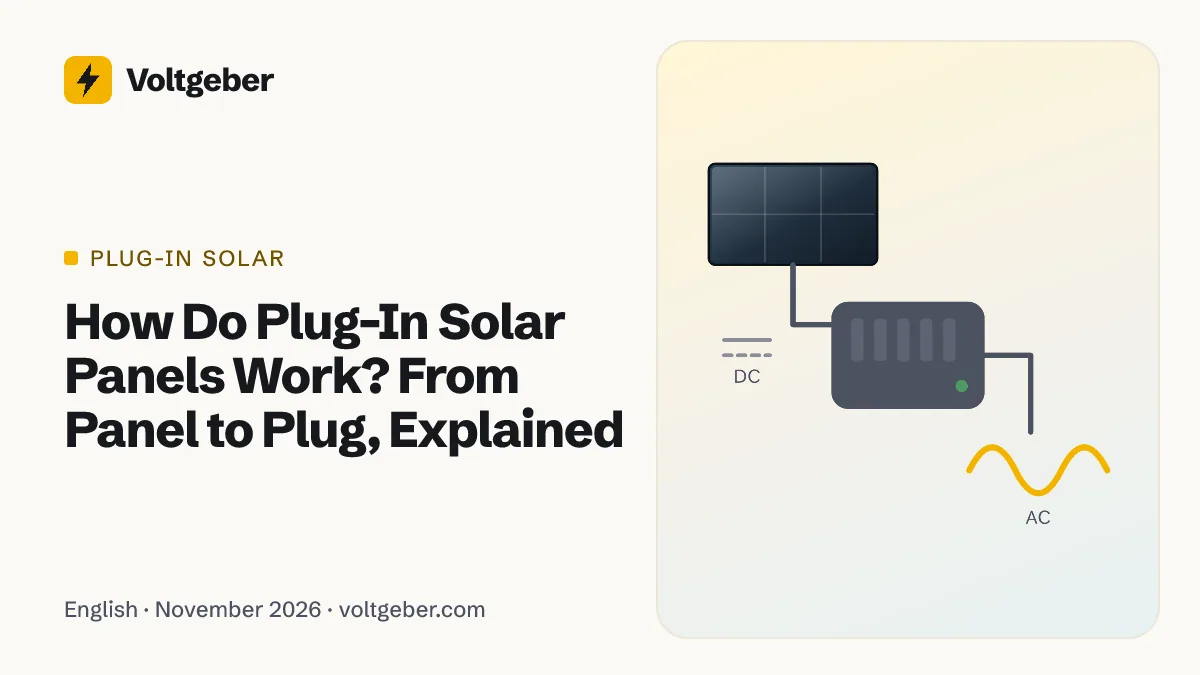
Plug-in solar panels, also called balcony solar, turn sunlight into direct current, and a microinverter behind the panels converts it into 230 V mains electricity in step with the grid. A lead with a moulded 13 A plug carries that power into an ordinary socket, and your home’s wiring delivers it to whatever is switched on. In Great Britain the device may feed in up to 800 W; anything your home is not using flows out through the meter to the grid.
The parts of a plug-in solar kit
The government’s Interim Product Specification, the technical rulebook every kit sold in Great Britain must meet since 27 August 2026, defines a plug-in solar device as at least one solar panel, a grid-following inverter, a factory-fitted lead with a BS 1363 plug, and a mounting system. In practice a kit looks like this:
| Part | What it does | UK requirement |
|---|---|---|
| Solar panels | Turn sunlight into direct current (DC) | Up to four panels, 2,000 W in total; open-circuit voltage at the inverter no more than 120 V DC |
| Microinverter | Converts DC into 230 V, 50 Hz alternating current (AC) and synchronises it with the grid | Maximum 800 VA and 3.5 A into the home |
| DC cables and connectors | Link panels to the inverter | Matched connector pairs supplied by the manufacturer; no Y-splitters |
| AC lead and plug | Carries mains power to the socket | Moulded BS 1363 plug, partially insulated pins, fuse of 5 A or less, extra contact protection |
| Mounting system | Holds the panels on a railing, wall, flat roof or ground stand | Structural analysis for UK wind and snow loads; no cable ties or straps as the only fixing |
| App or display | Shows output and fault messages | Required by the specification |
Some kits combine panel and inverter in one unit, which the specification calls a one-component device. Most are two-component (one panel plus inverter) or multi-component kits (two to four panels with one inverter), where you plug the DC connectors together yourself.
How a panel makes electricity
A solar panel is a sandwich of silicon cells. When light hits a cell, it knocks electrons loose and the cell’s built-in electric field pushes them in one direction: direct current. Panels sold for plug-in kits in 2026 are typically rated at 400 to 525 W each, a rating measured under laboratory sunlight of 1,000 watts per square metre at 25°C. British daylight rarely reaches that, so a 450 W panel spends most of the year producing a fraction of its rating.
Output follows light, not heat. Panels produce on overcast days, at a fraction of their sunny output, and actually work slightly more efficiently when cool. A bright, cold spring day can outperform a hazy hot one.
What the microinverter does
Your home runs on alternating current at about 230 V and 50 Hz. The microinverter does three jobs:
- Tracks the panels’ sweet spot. Its maximum power point tracker adjusts the electrical load on the panels many times a second to draw the most power from the light available.
- Converts DC to AC. Electronics chop and shape the panels’ direct current into a 50 Hz sine wave.
- Follows the grid. It measures the voltage and frequency at the socket and pushes current exactly in step with them. It is “grid-following”: it cannot create mains power by itself, only add to mains power that is already there.
The 800 W limit is set in the inverter. You can connect more panel capacity than that, up to 2,000 W, and the inverter will simply cap its output at 800 VA on bright days while producing more in the mornings, evenings and dull weather than a smaller array would. The specification asks manufacturers to advise a professional check of your installation above 960 W of panels.
How the power flows through your home
Electricity takes the path of least resistance. Picture a sunny afternoon with the kit producing 500 W and your home drawing 300 W for a fridge, a laptop and the router:
- The inverter pushes 500 W into the socket.
- The 300 W your appliances need is supplied from the panels, and your meter stops counting imported units for that power.
- The remaining 200 W flows back through the consumer unit and the meter into the street, where the nearest neighbour drawing power uses it.
If you switch on a 2 kW kettle at that moment, the kettle takes all 500 W from the panels plus 1.5 kW from the grid. You never need to choose which appliances run on solar; the physics does it.
Smart meters record imported and exported electricity separately, so exports do not reduce your bill unless you have an export tariff. If you have an older meter, check with your supplier how it handles exports before relying on it.
Why the UK limits are 800 W and one device
The 800 W figure follows Germany, where most plug-in kits are sold, and Ofgem noted in August 2026 that it matches the largest standard product on the market in countries where plug-in solar is legal. There is also a wiring reason specific to British homes.
Most UK sockets sit on a ring final circuit protected by a 32 A breaker. The breaker measures the current coming from the consumer unit; it cannot see current injected at a socket further round the ring. If a solar device feeds current into the ring while appliances on the same circuit draw heavily, parts of the cable can carry more than the breaker alone would allow. DESNZ commissioned a safety study on exactly this and concluded that devices used in Germany are safe on UK circuits within defined limits. Those limits are 3.5 A from the device, and one device per circuit. The network rules (Engineering Recommendation G98) go further and allow only one plug-in device per household, for now.
The safety systems that make a plug acceptable
A generator on a plug raises an obvious question: what stops the pins being live when you pull it out? The specification answers it in layers:
- Anti-islanding. The inverter must disconnect within 100 milliseconds of losing mains voltage, and the voltage at the plug pins must fall below 34 V within that time. This also stops the kit feeding a dead network while engineers repair it, which is why the kit gives no power in a power cut.
- A second line of defence. If the primary protection fails, a mechanical shutter or lock, or an independent electromechanical disconnection, must keep the pins safe. Partially insulated pins and a fuse of no more than 5 A complete the plug.
- Residual current protection. The device may leak no more than 5 mA of smooth DC into the installation, so it does not blind upstream RCDs. Manufacturers must tell you to check your consumer unit has modern residual current protection (RCBOs; MCBs behind a shared RCD may also be acceptable, pending further government testing) and to press the test button periodically while the panels are producing.
- No shortcuts. Extension leads, multi-way adaptors, travel adaptors and RCD adaptors are prohibited. Outdoor plugs, sockets and components must reach IP55.
Our guide to plug-in solar safety, UK sockets and RCDs goes through what to check in your own home.
Do plug-in solar panels really work?
They work as designed; the question is how much. The government’s July 2026 impact assessment modelled 800 W of panels with average UK sunshine and no shading:
| Mounting | Generated per year | Used at home (home-all-day household) | Approximate saving |
|---|---|---|---|
| Tilted 30°, facing south | 690 kWh | 428 kWh | about £110 |
| Vertical, facing east or west | 378 kWh | 272 kWh | about £70 |
For comparison, an average GB household used 3,323 kWh in 2024 by the government’s figures, so a well-placed kit generates the equivalent of roughly a fifth of a year’s electricity, while the share used as it is produced covers about 13 percent of the home’s demand. A vertical kit generates about a tenth and directly covers about 8 percent. Orientation, tilt and shade matter more than the brand of panel; see the best direction and angle in the UK and what plug-in solar saves.
How plug-in solar differs from rooftop solar
| Plug-in solar | Rooftop solar | |
|---|---|---|
| Size | Up to 800 W output | Typically 3 to 5 kW |
| Installation | By you, through a socket | By an MCS-certified installer, wired into the consumer unit |
| Network paperwork | You notify the DNO | Installer notifies the DNO under G98 or applies under G99 |
| Battery | Not allowed under current rules | Common |
| Export payments | Usually not, for now | Smart Export Guarantee available with MCS certification |
| Moves with you | Yes | No |
Setting one up, in outline
-
Check the kit is compliant. It must be listed as compliant on the ENA Type Test Register and state compliance with the Interim Product Specification. See is plug-in solar legal in the UK.
-
Check permission and the mounting surface. No timber balconies or timber or composite cladding. Ask your landlord or freeholder if the panels go on the outside of the building.
-
Mount the panels. Use the supplied mounting system and the manufacturer’s height and wind-load limits. Our guide to mounting a panel on a balcony railing covers this.
-
Connect the DC side. Click the panel connectors into the inverter with the AC plug out. Never disconnect DC connectors under load.
-
Plug into a socket circuit. No extension lead. Fix the supplied label near your consumer unit.
-
Notify your network operator. Follow the instructions supplied with the kit; see telling your DNO.
Next steps
Frequently asked questions
How do plug-in solar panels work?
The panels turn sunlight into direct current, a microinverter converts it into 230 V alternating current synchronised with the grid, and a lead carries it into a standard 13 A socket. From there it flows through your home's wiring to whatever is switched on, cutting what you draw from the grid.
Do plug-in solar panels really work?
Yes, within their size. The government's July 2026 analysis gives about 690 kWh a year for an 800 W kit tilted towards the south and about 378 kWh hung vertically facing east or west, worth roughly £70 to £110 a year. That is up to about a fifth of an average home's electricity, not all of it.
Do plug-in solar panels work in a power cut?
No. The inverter needs the grid's voltage to synchronise with, and the UK specification requires it to disconnect within 100 milliseconds when the grid fails. This protects engineers repairing the network and means the plug's pins are never live when unplugged.
Do plug-in solar panels work on cloudy days?
Yes, at reduced output. Panels respond to daylight, not heat, so they produce on overcast days, typically a fraction of their output in full sun. Over a British year, the dull days are already included in the government's annual figures.
Where does the electricity go if I am not using it?
Back through your meter into the local network, where neighbours use it. A smart meter records it as export. Without an export tariff you are not paid for it, which is why plug-in solar pays best when you use the power as it is produced.
Can I plug a solar panel into any socket?
Into any suitable socket on a socket circuit, but not a lighting circuit or a spur feeding fixed equipment such as a cooker or boiler. No extension leads, multi-way adaptors or RCD adaptors. Outdoor sockets must be weatherproof to at least IP55 under the specification.
Do plug-in solar panels need a battery?
No, and under the current UK rules they cannot have one. The specification covers solar devices without storage only, so the power is used live or exported.
Sources
- Plug-in Solar Device Interim Product Specification, version 2.0, July 2026
- SI 2026/848: Plugs and Sockets etc. (Safety) and ESQCR (Amendment) Regulations 2026
- Plug-in solar: government response (July 2026), technical annex
- Plug-in solar final stage impact assessment (16 July 2026)
- Ofgem decision to approve DCRP/MP/26/02 (11 August 2026)
- BS 7671 IET Wiring Regulations
This guide is general information, not legal, tax or electrical advice. Your utility, state and local code have the final say.