Plug-in solar
Plug-In Solar in Arizona: Legal Status, Bills and Rules in 2026
Arizona has no plug-in solar law as of November 2026; SB 1606 and HB 2843 stalled. What APS, TEP and SRP customers and HOA members can do now.
Key facts
- Arizona has no plug-in solar law as of November 2026; two 2026 bills, SB 1606 and HB 2843, did not become law.
- HB 2843 died in the House Natural Resources, Energy and Water Committee on February 17, 2026, when the chair held it without a vote over utility concerns.
- SB 1606 would have capped portable solar devices at 1,200 W on a 120 V outlet; Bright Saver lists it as deferred to the 2027 session.
- A.R.S. § 33-1816 bars planned-community associations from prohibiting solar energy devices but allows reasonable placement rules.
- Arizona's average residential rate was 15.05 cents per kWh in August 2026, below the US average of 18.16 cents (EIA, preliminary).
Plug-in solar is neither legalized nor banned in Arizona. As of November 2026 there is no plug-in solar law: HB 2843 died in committee in February 2026, and SB 1606, which would have allowed certified kits up to 1,200 W, did not become law. A grid-tied kit therefore falls under the interconnection rules of APS, TEP, SRP or your co-op, which generally require an application.
Where Arizona stands
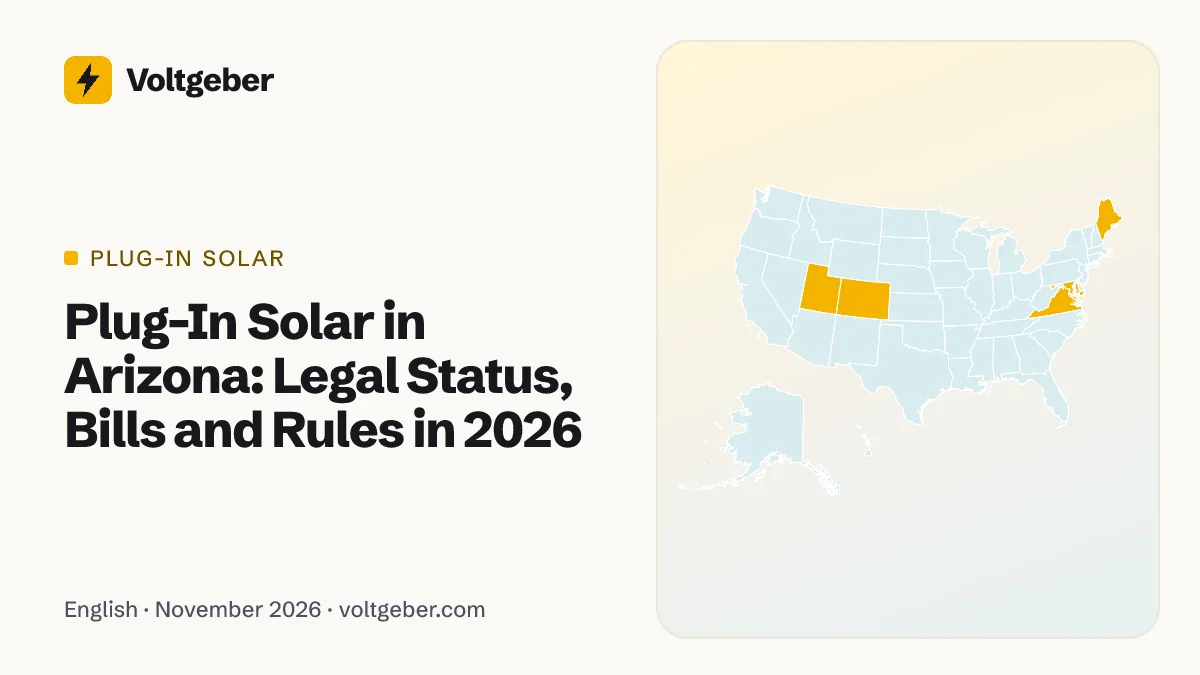
Ten states had signed plug-in solar laws by November 2026, according to Bright Saver’s tracker. They exempt a small certified device from the utility’s interconnection agreement, usually with a 1,200 W cap. Our plug-in solar laws by state overview describes the model. Arizona is one of the states where bills were filed and failed.
Bright Saver calls Arizona’s situation a legal gray area: utilities can require interconnection review, permits and fees, and there is no statutory protection for consumers. It does not ship its own kits to Arizona until the law changes.
The 2026 bills: SB 1606 and HB 2843
Two bills with the same aim reached the Legislature in 2026.
| Bill | Sponsor | Key provisions | What happened |
|---|---|---|---|
| SB 1606, plug in solar energy; requirements | Sen. Lauren Kuby, seven Senate co-sponsors and one House member | Portable device up to 1,200 W on a standard 120 V outlet, NEC-compliant and certified by a recognized lab; no utility approval, fee or extra equipment; limited utility liability | Not enacted; Bright Saver lists it as deferred to 2027 |
| HB 2843, portable solar power devices; requirements | Rep. Patty Contreras | No utility approval, fee or extra equipment; safety listing approved by the Corporation Commission; automatic disconnect; cities and counties barred from prohibiting compliant devices | Held without a vote in the House Natural Resources, Energy and Water Committee on February 17, 2026 |
SB 1606 followed the Utah template closely. It would have added a section for public power entities such as SRP to Title 30 and one for public service corporations such as APS and TEP to Title 40, and it would have required the device to stop energizing the building during an outage. It would also have excluded portable devices from the definition of a distributed energy generation system.
HB 2843 never got a vote. According to the Arizona Mirror, committee chair Gail Griffin allowed testimony but held the bill after reading a letter from an electric cooperative. The co-op worried that unmonitored devices could cluster on a circuit, that the bill defined few safety standards, and that it set no limit on devices per household. Griffin said she would work with the sponsor on a revised version for the next session.
What applies now: APS, TEP, SRP and the co-ops
Without a device law, a grid-tied kit is a customer generator like a rooftop array. Which rules apply depends on your utility.
- APS and TEP are regulated by the Arizona Corporation Commission, whose interconnection rules govern customer-owned generators running in parallel with the grid. Expect an application, a review and a permit from your city or county.
- SRP is a public power entity with its own board and its own interconnection process for customer generation.
- Electric cooperatives set their own policies. The co-op testimony against HB 2843 suggests they will be cautious.
None of them, as far as we found, has a published simplified path for plug-in kits as of November 2026. Call before you buy and describe the kit precisely: inverter rating, listing and how it connects. Our guide on telling your utility about plug-in solar lists what to ask.
HOAs: Arizona’s solar access law
Arizona’s homeowners have unusually strong solar rights. A.R.S. § 33-1816 says a planned-community association may not prohibit the installation or use of a solar energy device, whatever its documents say. It may adopt reasonable rules on placement, but not rules that prevent installation, impair the device’s function or make it more expensive or less efficient. A separate statute, § 33-439, voids deed restrictions that effectively prohibit solar devices.
Whether a plug-in kit is a solar energy device is the open question. Section 44-1761 defines the term broadly as a system that collects solar energy to provide electrical power mainly for on-site use at a residential dwelling, including storage. A ground-mounted kit in the yard of a single-family home looks like it fits. We know of no ruling on a plug-in kit, and SB 1606 would have carved portable devices out of a related definition, so treat the protection as likely rather than certain. Condo balconies are often common elements, where associations have more say. Our guide to plug-in solar and HOA rules covers the approval request.
What a kit would produce and save in Arizona
Arizona has one of the strongest solar resources in the United States, but its electricity is relatively cheap. EIA’s preliminary August 2026 average residential rate for Arizona is 15.05 cents per kWh, against 18.16 cents nationally.
Heat costs output. Panels lose a fraction of a percent of power for every degree above 25 °C cell temperature, and a dark panel in a Phoenix July runs far hotter than that. PVWatts accounts for this; the yields below, about 1.8 kWh per watt of panels per year when tilted south, already include it.
| Setup | Yearly output | Used at home | Savings at 15 cents |
|---|---|---|---|
| 400 W, tilted | about 720 kWh | about 85% | about $90 |
| 800 W, tilted | about 1,440 kWh | about 70% | about $150 |
| 800 W, vertical railing | about 1,000 kWh | about 75% | about $115 |
| 1,200 W, tilted | about 2,160 kWh | about 60% | about $195 |
Time-of-use plans change the picture. On the time-of-use plans of APS and SRP, the expensive hours fall in the late afternoon and evening, while a south-facing kit peaks around noon. If you are on such a plan, the savings per kWh are lower than the average rate suggests; a west-facing kit or a small battery shifts more output into the peak. Our cost and savings guide has prices and payback periods as of November 2026.
Options for Arizonans today
-
Ask your utility first. APS, TEP, SRP or your co-op can tell you whether a small kit can go through its interconnection process and what that costs.
-
Check your HOA or lease. For a house in a planned community, § 33-1816 limits what the association can refuse. For an apartment or condo balcony, get written permission.
-
Consider an off-grid setup. A portable power station charged by its own panels never connects to the grid, so no interconnection rules apply. It is less efficient than a grid-tied kit but legal everywhere.
-
Buy only listed hardware. If a 2027 law passes, it will almost certainly require certification of the device, as every enacted state law does. A kit bought now that lacks a UL listing may not qualify later.
-
Follow the 2027 session. Check the Legislature’s bill search for plug-in or portable solar bills from January 2027.
What a 2027 law would likely look like
If the sponsors return with Utah-style language, expect a 1,200 W cap, a 120 V outlet, certification by a recognized testing laboratory and a ban on utility approval and fees. The co-op objections point to the likely compromises: a limit on devices per household, a notification step like Maryland’s or Virginia’s, and clearer safety definitions, perhaps a reference to the UL 3700 standard that did not exist in final form when the 2026 bills were written.
Next steps
Frequently asked questions
Is plug-in solar legal in Arizona?
There is no Arizona law that allows plug-in solar as its own category, and none that bans it. A kit connected to the grid is a customer-owned generator, so the interconnection rules of APS, TEP, SRP or your co-op apply, and those generally require an application. Bright Saver describes Arizona's status as a legal gray area.
What happened to Arizona's plug-in solar bill?
There were two. HB 2843, sponsored by Rep. Patty Contreras, was held without a vote in the House Natural Resources, Energy and Water Committee on February 17, 2026. SB 1606, sponsored by Sen. Lauren Kuby, did not become law; Bright Saver lists it as deferred to 2027.
Can my HOA ban solar panels in Arizona?
Not outright. A.R.S. § 33-1816 says a planned-community association may not prohibit the installation or use of a solar energy device, though it may adopt reasonable rules on placement. Whether a small plug-in kit counts as a solar energy device under § 44-1761 has not been tested as far as we know, but the definition is broad.
Do I need APS approval for a small solar panel kit?
For a kit that feeds power into your home's wiring while connected to the grid, expect the answer to be yes: APS and TEP follow the Arizona Corporation Commission's interconnection rules, which cover customer generators of any size. Ask the utility before you buy. A panel that only charges a portable power station never connects to the grid and needs no approval.
How much would a plug-in solar kit save in Phoenix?
An 800 W kit tilted toward the south produces about 1,440 kWh a year in Phoenix. If 70 percent is used at home at 15 cents per kWh, that is roughly $150 a year. On a time-of-use plan the value can be lower, because most solar output falls outside the late-afternoon peak.
Will Arizona pass a plug-in solar law in 2027?
It is possible but not certain. The House committee chair said she would work with the sponsor on a revised bill for the next session, and Bright Saver expects SB 1606 to return. Utility and co-op concerns about safety and unmonitored devices will shape any new version.
Sources
- SB 1606, plug in solar energy; requirements (57th Legislature, 2nd Regular Session)
- House summary of HB 2843, portable solar power devices; requirements
- A.R.S. § 33-1816: Solar energy devices; reasonable restrictions
- A.R.S. § 33-439: Restrictions on solar energy devices void
- A.R.S. § 44-1761: Definitions (solar energy device)
- Utility concerns kill AZ bill allowing solar panels in yards, on balconies (Arizona Mirror, February 18, 2026)
- Is plug-in solar legal in Arizona?
- Electric Power Monthly, Table 5.6.A: Average price of electricity to ultimate customers by state
- Plug-in solar panels bill failed in Arizona. Here's how the new law is working in Utah
This guide is general information, not legal, tax or electrical advice. Your utility, state and local code have the final say.