Plug-in solar
Maine Balcony Solar Law: The 420 W and 1,200 W Rules Explained
Maine balcony solar is legal since July 15, 2026: up to 420 W with no notice, up to 1,200 W with an electrician, a dedicated outlet and a utility form.
Key facts
- LD 1730 (Public Law 2025, chapter 644) was signed on April 6, 2026 and added section 3475 to Title 35-A of the Maine Revised Statutes.
- Up to 420 W of combined inverter output per service address needs no electrician and no utility notice.
- From 420 W to 1,200 W, each system needs a Maine-licensed electrician, a dedicated circuit with a single outlet, and notice to the utility within 30 days.
- Utilities may not require approval, an interconnection agreement, a fee or extra equipment, and plug-in systems cannot use net energy billing.
- Maine's average residential rate was 32.11 cents per kWh in August 2026, one of the highest in the country (EIA, preliminary).
Maine balcony solar is legal. LD 1730, in effect since July 15, 2026, lets any electricity customer run certified plug-in solar of up to 1,200 W without an interconnection agreement. Up to 420 W per address needs no electrician and no notice. Above 420 W, each system needs a licensed electrician, a dedicated circuit with one outlet, and a notice to the utility within 30 days.
What LD 1730 says
The law is short and specific. It added section 3475 to Title 35-A of the Maine Revised Statutes, the title that governs public utilities. The bill, sponsored by Senator Nicole Grohoski, became Public Law 2025, chapter 644. Its formal title is about the state’s beneficial electrification policy, which is why it does not show up in searches for “balcony solar.”
The statute covers two kinds of devices. A plug-in photovoltaic system connects through a standard outlet, is meant primarily to offset part of your own consumption, and uses inverters that shut off within 0.2 seconds if grid power is disrupted. A plug-in battery system is an AC-coupled storage unit that plugs into an outlet and can charge and discharge on its own. Either counts as an eligible system if its export capacity is 1,200 W or less and it meets a recognized safety standard.
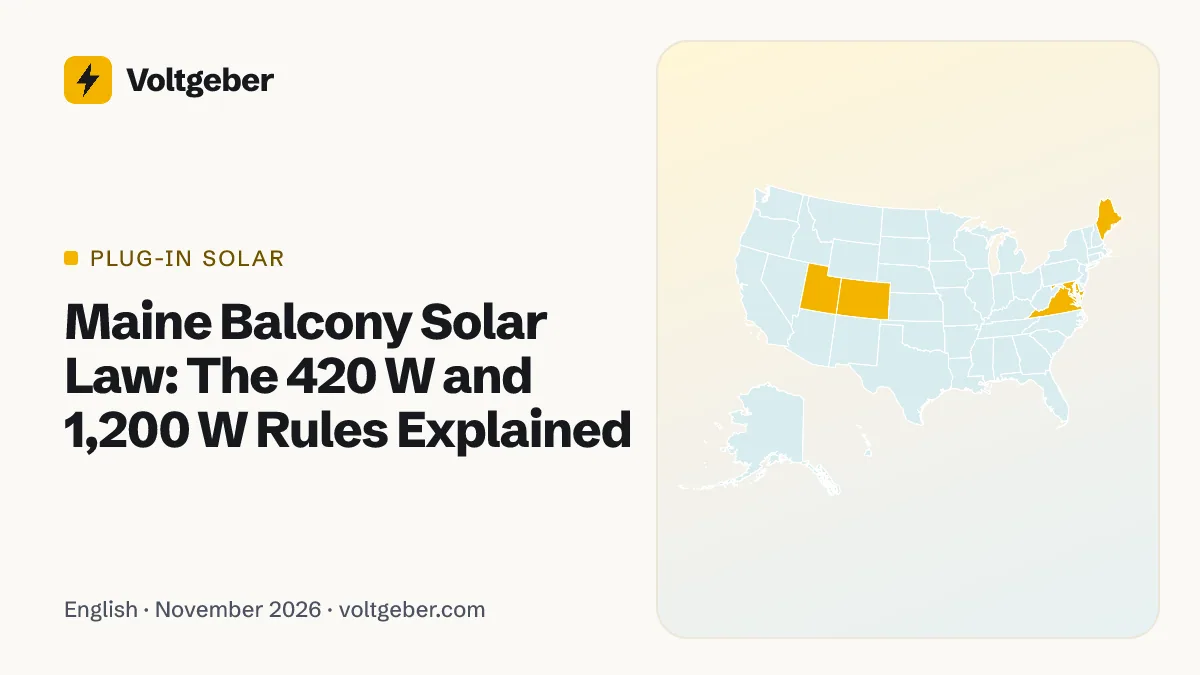
Maine was among the first states to follow Utah, whose law dates from 2025. Its two-tier design, with a lower threshold for standard outlets, is unusual; Maryland and Virginia later used a 391 W threshold for a similar purpose. Our overview of plug-in solar laws by state compares the states.
The two tiers: 420 W and 1,200 W
The limits apply per service address, which in practice means per electricity account and meter.
| Requirement | Up to 420 W combined | 420 W to 1,200 W |
|---|---|---|
| Measured as | combined AC inverter output | combined AC inverter output, at most 1,200 W |
| Installer | you | Maine-licensed electrician |
| Circuit | existing outlet allowed | dedicated circuit with a single outlet |
| Notice to the utility | none | within 30 days, on the PUC form |
| Utility approval or agreement | not allowed | not allowed |
| Fees or extra equipment | not allowed | not allowed |
| Net energy billing | excluded | excluded |
The 420 W tier fits one large panel with a small microinverter, or two small panels. The reasoning behind a lower tier is the shared household circuit: a breaker only sees the current coming from the panel, not the extra current a kit feeds in further down the line, so the amount added to an ordinary circuit is kept small. Above 420 W the law wants the inverter on its own circuit, so the current from the kit and the current drawn by appliances never add up on the same cable.
Certification: what counts as an eligible system
The statute accepts three paths. A system qualifies if it is listed or certified to UL 3700 and any other applicable UL or National Electrical Code standards for plug-in systems, if it meets a comparable standard from a nationally recognized testing laboratory, or if it is configured under the National Electrical Code as adopted by the Electricians’ Examining Board.
UL 3700 is the new North American safety standard for plug-in solar. UL Solutions launched its certification program in January 2026, and Hoymiles announced the first UL 3700-compliant plug-in microinverter in July 2026. A listed microinverter is not the same as a listed kit, though, and Bright Saver says it does not ship to Maine until full-system UL 3700 certification is complete. As of November 2026, ask the seller for the certificate covering the complete system and the testing laboratory that issued it.
How to notify Central Maine Power or Versant Power
The notice is a form, not an application. The utility cannot refuse a compliant system, and it cannot require an interconnection study, a fee or additional equipment.
-
Add up your inverter output. If all plug-in systems at your address together stay at 420 W or below, you are done; no form is required.
-
Have the electrician install the outlet. For anything above 420 W, a Maine-licensed electrician installs a dedicated circuit with one outlet for each system and connects it under the electrical code.
-
Download the Commission’s form. The Maine Public Utilities Commission publishes the plug-in solar form on its website. It asks for your service address, the inverter capacity and a statement that the system complies with section 3475.
-
Send it to your utility within 30 days. Email or mail it to Central Maine Power or Versant Power using the contact on the Commission’s page or your utility’s balcony solar page. Do not send it to the Commission.
-
Keep a copy. Save the form, the electrician’s invoice and the product certificate. They answer any later question from the utility, your landlord or your insurer.
Our guide on telling your utility about plug-in solar compares Maine’s notice with the rules in Maryland and Virginia.
What a kit saves at Maine’s electricity rates
Maine’s high rates make plug-in solar worth more here than in most states. EIA’s preliminary August 2026 figure for Maine is 32.11 cents per kWh, against a US average of 18.16 cents. Because surplus earns nothing, the share of output you use at home matters more than the panel size.
The table assumes south-facing panels, a yield of about 1.3 kWh per watt of panels per year when tilted (PVWatts range for Portland and Bangor, rounded) and 32 cents per kWh.
| Setup | Yearly output | Used at home | Yearly savings |
|---|---|---|---|
| 420 W, tilted | about 545 kWh | about 85% | about $150 |
| 420 W, vertical railing | about 400 kWh | about 90% | about $115 |
| 800 W, tilted | about 1,040 kWh | about 70% | about $235 |
| 1,200 W, tilted | about 1,560 kWh | about 60% | about $300 |
Above 420 W, add the electrician to the price. A dedicated circuit is a small job in a house with space in the panel and a short run to the outside wall, and a larger one in an older apartment building. Ask for a quote before you choose the bigger kit, because the 420 W tier often has the shorter payback. Our cost and savings guide covers kit prices as of November 2026.
Winter, snow and the Maine climate
Maine’s winter sun is low and short. A kit produces far less from November through February than in the summer months, and snow on a tilted panel stops production until it slides off. A panel mounted vertically on a south-facing railing sheds snow and catches the low winter sun at a better angle, which narrows the gap to a tilted panel in the months when your bill is highest.
Wind matters on the coast. Use brackets rated for the panel’s weight and area, and do not rely on cable ties.
Renters, condos and the structure clause
Section 3475 does not mention landlords or associations. It neither requires their permission nor overrides a lease or condo declaration. What it does say is that a customer installing a system on a structure the customer does not own must make sure the installation does not compromise the structure and does not violate state or local building, fire or zoning codes, and must restore the structure to its prior condition when the system is removed.
That clause puts the responsibility on you, which is a good argument when you ask a landlord: no drilling, a clamp mount and a written promise to restore. Our guide for renters has a checklist for the request, and the guide to HOA rules covers associations.
Utility liability and what the law leaves out
The statute shields the utility from liability for damage or injury caused by a customer’s compliant system. In practice that means the risk sits with you and your insurer, so tell your homeowners or renters insurer about the kit.
The law also does not change the electrical code for anything else. A system above 1,200 W, or one that does not meet a recognized standard, remains an ordinary generator that goes through the utility’s interconnection process and, if you want credit for exports, net energy billing.
Next steps
Frequently asked questions
Is balcony solar legal in Maine?
Yes. LD 1730, signed on April 6, 2026, lets any retail electricity customer install certified plug-in solar or plug-in battery systems with an export capacity of up to 1,200 W. Bright Saver and Versant Power give July 15, 2026 as the date it took effect. Systems above 420 W need a licensed electrician, a dedicated circuit and a notice to the utility.
Do I need to tell CMP or Versant about my plug-in solar kit?
Only if the combined inverter output at your service address exceeds 420 W. Then you send the Maine Public Utilities Commission's plug-in solar form to your utility within 30 days of installation, not to the Commission. The form asks for your service address, the inverter capacity and a statement of compliance.
Can I plug an 800 W kit into any outlet in Maine?
No. Above 420 W the statute requires installation by a Maine-licensed electrician on a dedicated circuit with a single outlet. A kit of 420 W or less may use an existing outlet, though NRCM still suggests having an electrician check the installation.
Does plug-in solar get net energy billing credits in Maine?
No. Section 3475 says plug-in systems installed under it may not be used for net energy billing. Surplus electricity that flows to the grid earns no credit, so size the kit to what your home uses during the day.
Can I buy a certified plug-in kit in Maine yet?
Availability is limited as of November 2026. The statute accepts UL 3700 listing, a comparable standard from a recognized testing laboratory, or a configuration under the electrical code as adopted by the Electricians' Examining Board. Bright Saver says it does not ship to Maine until full-system UL 3700 certification is complete.
Do renters in Maine need landlord permission for balcony solar?
The law does not give landlords a veto, and it does not override your lease either. It does require you to keep the building's structure intact, comply with building, fire and zoning codes, and restore the structure when you remove the system. Get written permission if your lease restricts attachments.
Sources
- 35-A MRSA § 3475: Plug-in photovoltaic and plug-in battery systems
- LD 1730 (SP 676), An Act Regarding the Beneficial Electrification Policy of the State
- Plug-In Solar Form
- Balcony solar
- What to know about Maine's new plug-in solar law
- Electric Power Monthly, Table 5.6.A: Average price of electricity to ultimate customers by state
- UL Solutions debuts testing and certification framework for safer plug-in solar
- Hoymiles introduces HiFlow Pro, the first UL 3700-compliant plug-in microinverter in the US
- Is plug-in solar legal in Maine?
This guide is general information, not legal, tax or electrical advice. Your utility, state and local code have the final say.