Plug-in solar
Plug-In Solar in Winter: What Output to Expect in the UK
An 800 W plug-in solar kit makes about 15 to 35 kWh in a UK December, roughly a sixth of a summer month. Monthly figures, savings and how to get more in winter.
Key facts
- In London, PVGIS models about 27 kWh in December from 800 W of panels tilted 30 degrees south, against about 100 kWh in June.
- November to February together produce about 17 percent of the year's output for that position, and April to September about 68 percent.
- Vertical south-facing panels produce more than tilted ones in December, about 35 kWh in London in the same model.
- In the London model, a typical December day yields about two-thirds of a kilowatt-hour, and more than a quarter of December days less than 0.3 kWh.
- At the October to December 2026 price cap of 26.32p per kWh, a December's output of 27 kWh is worth about £7.
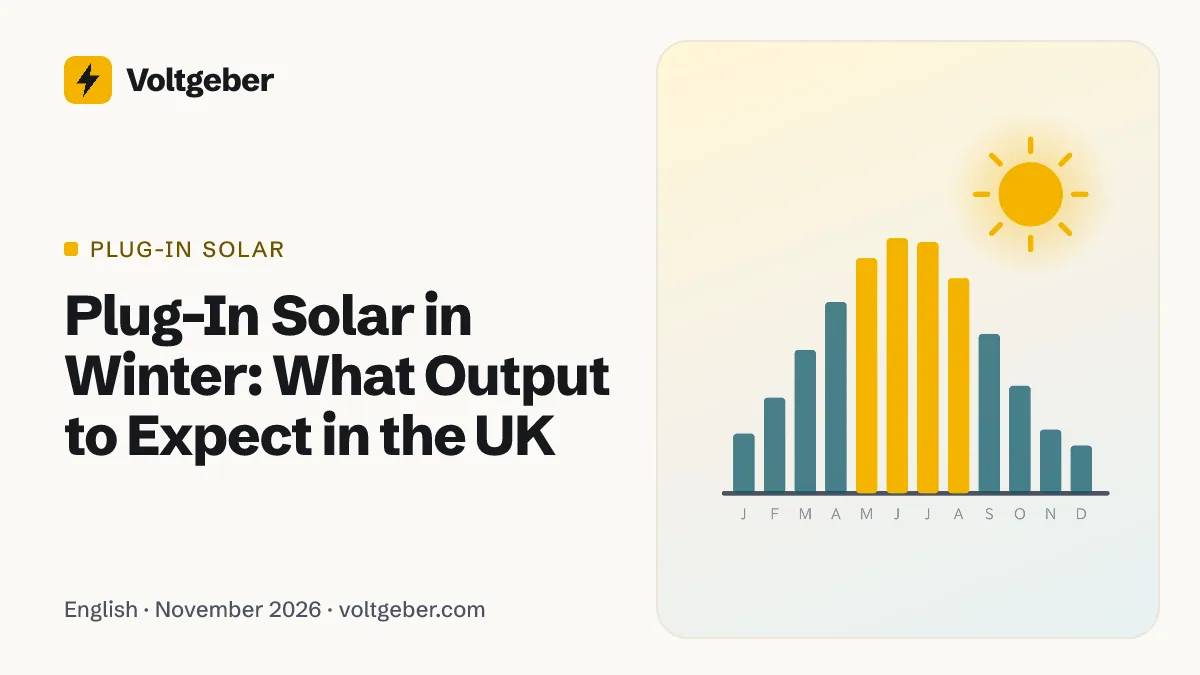
Plug-in solar keeps working in a British winter, but at a fraction of its summer output. In London, an 800 W kit tilted 30 degrees towards the south makes about 27 kWh in December in the European Commission’s PVGIS model, against about 100 kWh in June; in Edinburgh, about 16 kWh. November to February together supply about a sixth of the year’s electricity. Steeper, unshaded panels do noticeably better.
Month by month
We modelled 800 W of panels with PVGIS, using its standard 14 percent system losses and 2005 to 2023 weather data. Figures are kilowatt-hours per month, rounded.
| Month | London, 30° south | London, vertical south | London, vertical west | Manchester, 30° south | Edinburgh, 30° south | Edinburgh, vertical south |
|---|---|---|---|---|---|---|
| January | 31 | 37 | 10 | 20 | 21 | 28 |
| February | 41 | 42 | 17 | 34 | 35 | 39 |
| March | 68 | 57 | 32 | 61 | 61 | 54 |
| April | 91 | 62 | 47 | 84 | 84 | 60 |
| May | 97 | 53 | 53 | 92 | 97 | 57 |
| June | 100 | 50 | 54 | 90 | 90 | 49 |
| July | 100 | 52 | 55 | 88 | 92 | 52 |
| August | 89 | 55 | 48 | 78 | 82 | 53 |
| September | 75 | 58 | 37 | 64 | 65 | 52 |
| October | 53 | 51 | 23 | 44 | 43 | 43 |
| November | 36 | 43 | 13 | 28 | 28 | 36 |
| December | 27 | 35 | 9 | 21 | 16 | 23 |
| Year | 808 | 594 | 399 | 704 | 714 | 546 |
For the London tilted case, April to September produce about 68 percent of the year’s total and November to February about 17 percent. The government’s July 2026 model, which uses average UK sunshine, gives a lower year of 690 kWh for the same position, so treat these as the upper middle of the British range.
Two patterns matter for winter. Vertical south-facing panels beat tilted ones from October to February, because they face the low sun almost square on. And east or west-facing panels collapse in winter: a vertical west-facing kit in London makes about 9 kWh in December, a third of a tilted south-facing one.
What a winter day looks like
Monthly totals hide how uneven winter is. In the London model, December days for a 30-degree south-facing 800 W kit ranged from under 0.1 kWh to just over 2 kWh, with a typical (median) day at about two-thirds of a kilowatt-hour. More than a quarter of December days produced less than 0.3 kWh.
Around midday, the median output was about 115 W, enough to cover a fridge and a router. On clear days it reached around 400 W, with the highest hour near 460 W. An 800 W inverter is almost never the limit in winter, which is why extra panel capacity pays off in these months: in the same model, 1,600 W of panels behind an 800 W inverter roughly doubled November to February output. Our 800 W vs 400 W comparison has the figures.
Why winter output is so low
Short days. Around the winter solstice, London has roughly eight hours between sunrise and sunset and Edinburgh about seven, against more than sixteen in London in June.
Low sun. At midday on the shortest day, the sun is about 15 degrees above the horizon in London and about 11 degrees in Edinburgh. Its light crosses more atmosphere and strikes a tilted panel at a glancing angle.
Long shadows. At 15 degrees of elevation, a two-metre wall or balcony parapet casts a shadow more than seven metres long. Trees, neighbouring buildings and the balcony above that are harmless in summer can shade your panels for the whole day.
Cloud. British winters are cloudy, and diffuse light delivers a small fraction of direct sunshine. Cold, by contrast, helps: solar cells are slightly more efficient at low temperatures, so a bright frosty day is often the best of the month.
What winter output is worth
Almost every winter unit is used in the home. Output rarely exceeds the background demand of a fridge, freezer, router and devices on standby, so little is exported unpaid. At the Ofgem price cap of 26.32p per kWh for October to December 2026:
| Position, London model | December output | December value | November to February output | November to February value |
|---|---|---|---|---|
| 30° south | about 27 kWh | about £7 | about 135 kWh | about £36 |
| Vertical south | about 35 kWh | about £9 | about 156 kWh | about £41 |
| Vertical west | about 9 kWh | about £2 | about 50 kWh | about £13 |
The cap for January to March 2027 is due to be announced in late November 2026; the value per unit moves with it. Over a full year the government estimates savings of about £70 to £110 for an 800 W kit, most of it earned between spring and autumn; see how much plug-in solar saves.
How to get more in winter
-
Steepen the angle if you can. On an adjustable ground or flat-roof stand, 60 to 70 degrees facing south produced about 30 percent more in December than 30 degrees in the London model. Use only angles the manufacturer’s instructions allow.
-
Clear winter shade. Trim what you are allowed to trim, and if you have the choice of position, pick the one that sees the sun at noon in December.
-
Keep the glass clean. Leaves, moss on the frame and bird droppings cost more when light is scarce. Use water and a soft brush from a safe position.
-
Run appliances at midday. Winter output peaks between about 11am and 2pm. A dishwasher or washing machine on a timer then uses more of it.
-
Check the fixings after storms. The specification requires manufacturers to give recommended intervals for visual checks of fixings, cables and connectors. Winter gales are the time to follow them.
Snow, frost and storms
Snow. A layer of snow stops output until it slides or melts off, which on a tilted or vertical panel is usually within a day or two. If you can brush it off safely from the balcony floor or the ground, do; never climb onto a roof or lean over a railing. The mounting system must be designed for UK snow loads where relevant.
Frost and condensation. Panels and microinverters are built for outdoor use, with outdoor components rated at least IP55. Frost on the glass clears as the sun rises.
Wind. The kit’s mount must withstand UK wind loads for the heights stated in the instructions. Panels that rattle, brackets that have moved or cables rubbing on edges need attention before the next storm. The London Fire Brigade advises stopping use at once if you notice damage, burning smells or repeated tripping.
Power cuts. Winter storms bring them. Your kit switches off automatically when the grid fails and restarts when power returns. It cannot run your home during a cut, and storing summer surplus for winter evenings is not an option either: batteries are excluded from plug-in kits under the current rules; see plug-in solar with a battery.
Should you unplug in winter?
No. A compliant kit draws almost nothing at night, takes no harm from cold and still saves money on bright winter days. Leave it connected. If you do take it down for the winter, for example to protect it on an exposed balcony, the network rules may treat that as removal: they require you to notify your distribution network operator when a device is decommissioned, so the safe course is to notify on removal and again when you reconnect. Our DNO guide explains how.
Next steps
Frequently asked questions
Does plug-in solar work in winter?
Yes, but at a fraction of its summer output. Panels respond to daylight, not warmth, so they produce on bright and overcast winter days, just much less. In London an 800 W kit tilted south makes about 27 kWh in December in the PVGIS model, compared with about 100 kWh in June.
How much does an 800W plug-in solar kit produce in December in the UK?
Roughly 15 to 35 kWh, depending on where you live and how the panels face. PVGIS gives about 27 kWh in London and 16 kWh in Edinburgh at a 30-degree tilt facing south, and about 35 kWh and 23 kWh with the panels vertical. Vertical east or west panels give under 10 kWh.
Do solar panels work on cloudy days?
They do, at a reduced rate. Diffuse light through cloud still reaches the panels; output on a dull winter day may be a tenth of a bright day's or less. In the London December model the median noon output of an 800 W kit was about 115 W, rising to around 400 W on clear days.
Is plug-in solar worth it if winter output is so low?
Judge it over the year. About two-thirds of the yearly output arrives between April and September, which is where most of the £70 to £110 annual saving in the government's model comes from. Winter adds a smaller amount, nearly all of it used in the home.
What angle is best for plug-in solar in winter?
Steep. In the London model, 60 to 90 degrees facing south produced about 30 percent more in December than a 30-degree tilt. If your stand is adjustable, steepen it from October to February; on a railing, a vertical south-facing panel is already well placed for winter.
Should I clear snow off plug-in solar panels?
Only if you can do it safely from the ground or the balcony floor with a soft brush. Snow slides off tilted panels within hours or days, and the output lost in the meantime is small. Never climb on a roof or lean over a railing to clear panels.
Sources
- PVGIS: Photovoltaic Geographical Information System (version 5.3)
- Plug-in solar final stage impact assessment (16 July 2026), paragraphs 32 to 35
- Changes to energy price cap between 1 October and 31 December 2026
- Plug-in Solar Device Interim Product Specification, version 2.0, July 2026, sections 5.5.1 and 8.3
- Plug-in solar panels: safety advice for residents and homeowners
This guide is general information, not legal, tax or electrical advice. Your utility, state and local code have the final say.